

When Yuwadee Viriyangkura needed more experts and broader perspectives to provide professional development to educators in Thailand, she remembered a classmate and friend from her doctoral studies at Illinois State University.
Viriyangkura is the creator of the well-regarded Association of Thai Special Education Teachers, a small nonprofit that for five years has advanced the teaching and educational practices of those working with individuals with special needs.
Part of that endeavor for the former assistant professor at Chiang Mai University is making sure that teachers are ready and comfortable to welcome children with disabilities in their classrooms, skills not covered in their undergraduate preparation.
Contacting Baker, an associate professor in the NIU Department of Special and Early Education (SEED), upped Viriyangkura’s game.
Baker teaches courses on assessment in early childhood special education. She also researches how assessment and supports expand access to, and success in, inclusive settings across the lifespan for students with intellectual and developmental disabilities.
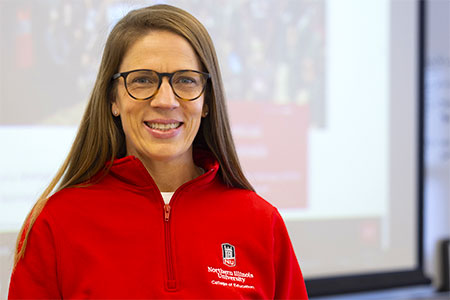
“Early intervention is still not mandated in Thailand, and they want it. They’re trying. They’re working with the government to try to get that established, but they need to have good knowledge about it,” Baker says.
“Taking our framework over, and the research we’re doing in the United States that’s aligned with other countries that have mandated early interventions, is really critical information for them to move forward,” she adds. “It’s the same thing with differentiated instruction, and it’s just been within the last recent years that they mandated inclusion.”
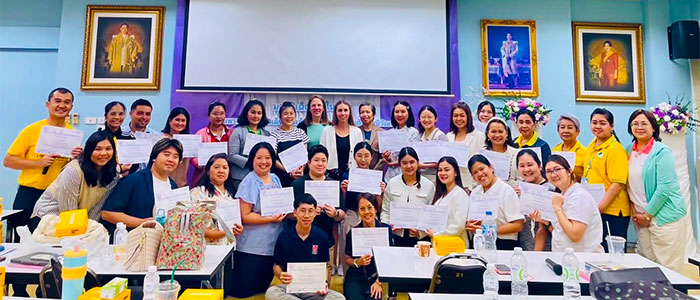
Baker and NIU colleague Natalie Andzik, also an associate professor in SEED, traveled to Thailand in June to present two three-day workshops, one focused on early childhood education and the other on special education, with the assistance of translators.
Andzik was honored to join Baker not only in delivering the training but also in talking to faculty at Chulalongkorn University and Navamintratirat University “who are really desperate to learn more about this themselves and to bring this into their higher education classes.”
“Stephanie and I came into this field wanting to help children, and sometimes that means helping adults to help the children. That’s how we found ourselves out of the classroom and in higher education,” Andzik says.
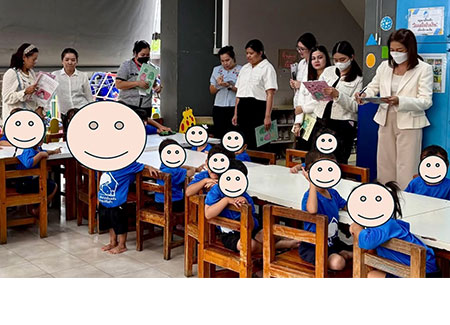 “Kids in other countries need us just as much,” she adds, “so it’s great to have this nonprofit organization that has that same mission – helping kids with disabilities – and because we have the same mission, and we have all of this day-to-day, rich experience, and we’ve been living and breathing it and learning it in our undergraduate programs because it’s just the law in our country and we know it so well, then of course it makes the most sense to bring us over to talk about it.”
WORKSHOP ONE INVOLVED about 40 participants from the Foundation for Slum Child Care (FSCC).
FSCC is a nonprofit in Thailand that since 1994 has been providing early childhood education and care services to children ages 6 and younger, and to their families, who live in communities plagued by poverty.
“In the United States, we find out – literally at birth – that the child has disabilities. We provide services right away,” Andzik says.
“In Thailand, that’s not as accessible. That’s not their model,” she adds, “so Stephanie told them how we do things in the United States. We had teachers present. We had doctors present. We had nurses present. We had people who run daycare programs present. We had family members present.”
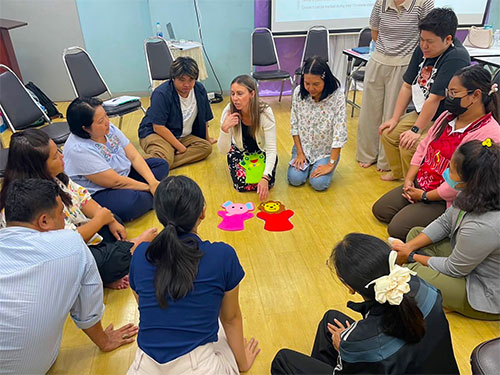
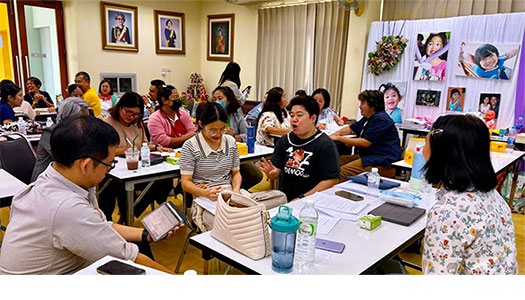
Days One and Two were mostly filled with lectures and small-group activities.
Day Three, however, involved a hands-on field trip to “go work with babies,” Andzik says. “We were at an infant-preschool center where they support very young children, and we had the participants work with the kids and use some of the strategies that Stephanie had taught them the previous two days.”
A separate group, consisting of special education teachers and school administrators and also numbering around 40, attended Workshop Two to learn about differentiated instruction.
Children with special needs, including autism, Down syndrome, vision impairments and hearing loss, are already attending general education classrooms in Thailand alongside their peers without disabilities.
However, most teachers – especially those in public schools – lack the appropriate training and/or support from paraprofessionals who usually also are missing that level of preparation.
“Natalie took the lead and focused on walking the teachers on what differentiated instruction means, how to go about doing it and looking at it across different needs that students might have across different grade levels and ability levels,” Baker says.
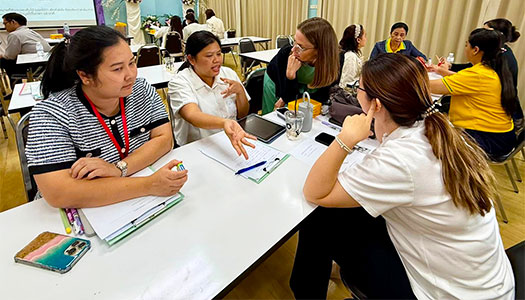
“Similar to what we did in the first workshop, we had teachers on the third day go into different classrooms, based on the areas they’re already teaching in, or based on the grade levels they’re teaching and feel comfortable working in,” she adds. “They created a lesson and went in and delivered that lesson with differentiated instruction and differentiated activities.”
PARTICIPANTS AT BOTH WORKSHOPS enjoyed their time with the NIU professors.
“Yuwadee did a survey because it was a paid, professional development opportunity,” Baker says, “and when we looked at the feedback, the feedback was positive. They all took a ton of information away, and they were appreciative.”
Maybe that gratitude will turn into reform, Andzik adds.
“Stephanie and I have been to several Asian countries, and all of these countries we’ve been to have all been a couple decades behind when it comes to supporting kids with disabilities,” she says.
“They don’t have ramps, and they don’t have ADA, so bringing us over was just kind of a breath of fresh air for them. We’re like, ‘It works. We promise it’s successful. We have books. We have classes. We have programs,’ ” she adds. “Stephanie and I have never felt like our job is ever done, so if there’s an entire other country that could benefit from learning for us for a couple of days, sign us up. Just tell us what flight you want us on.”
More flights – of a different kind – are also in the cards.
Baker and Andzik clearly returned home with eyes opened to how their field operates in Thailand, and that they need to carefully consider how they practice in another country, realizations they believe would benefit their Huskies.
“Language is very literal, and we live in a society where our language is just very messy and full of acronyms and jargon, and that was challenging in and of itself to slow our pace down and to make our language clear and concise so that typically developing adults could access our content,” Baker says. “That lens is important.”
 And, she adds, “understanding where the Thai society is in terms of educating all people was interesting for us to learn. The applicability of that here is just to help our students understand that what we have here has a lot of room for growth but that we’re lucky. We’re privileged in a lot of ways in the United States.”
Consequently, Andzik says, “our next step is to apply for an Educate Global grant to get some of our NIU students over there because we’d really like them to have this experience.”
“We’re hopeful to include our students in our learning so they can get a better sense of difference and acceptance and adjustment and language and culture,” she says, “and to be grateful for the privilege that we have but also to see some of the ways that we can grow as well.”
