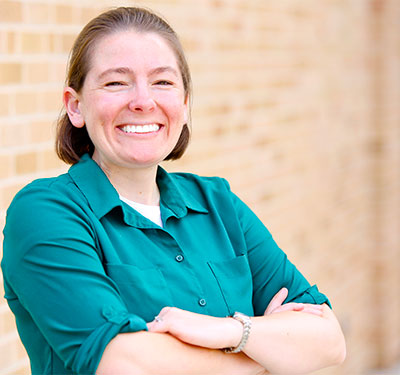
Not one moment of Stacy Kelly’s career has transpired outside the realm of visual disabilities.
“I always knew, from an early age, that I wanted to be a teacher. I really like everything about school and learning,” says Kelly, professor in the Department of Special and Early Education, “and as I grew up and went to high school, I learned there’s an area called ‘special education,’ and it sounded really fun and that it would add an element to being a teacher. So, I decided, ‘Yeah, I want to be a special education teacher.’ ”
Once in college, however, the just-arrived-on-campus freshman was told that “special education” wasn’t specific enough. She would need “to pick one.”
Pick one? But she already had, she told her academic advisor. She had picked special education. No, came the reply. A disability area. She needed to choose a disability area.
Feeling suddenly overwhelmed and not ready to make that kind of decision, she asked for time.
Smart.
“The second month after that meeting with the advisor, there was a Family Weekend event for the college that I was in, so I attended with my family. We took one step off the elevator, and the first thing was a table of all things blindness and low vision. It was so interesting,” Kelly says.
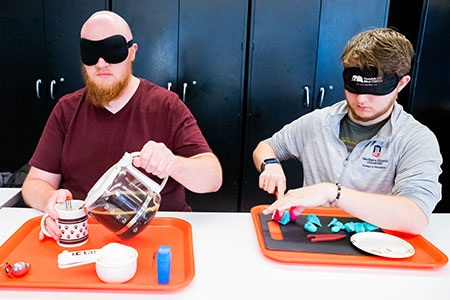
“A professor behind the table was there to talk with you and answer your questions, so I looked at this stuff – long canes and braille and talking devices and magnifiers and tactile graphics – and it was really intriguing.”
Kelly’s one-minute conversation with that professor led to a quick, and life-changing, realization.
“I asked her, ‘How do I pick this as my area of special ed?’ And she said, ‘You just did,’ ” she says. “I was 18 years old, just starting my freshman year, and from that moment on, I never, ever looked back.”
More than two decades later, Kelly has built her own legacy of bringing fresh faces into her favorite field – and the NIU Graduate School is impressed.
She is the recipient of one of two 2024-2025 Distinguished Graduate Faculty Awards, which recognizes excellence in mentoring of master’s and doctoral students through direct engagement and scholarly achievements. The other goes to Jenn Jacobs, associate professor in the Department of Kinesiology and Physical Education, who will receive her recognition in May.
Jessica Reyman, acting dean of the Graduate School, honored Kelly at the December commencement, where she served as mace bearer.

“What it means to me is a lot,” Kelly says, “because all I’ve ever wanted to be was a teacher. It feels like you’re making difference, and the gratification is almost instant – even when you don’t have your best lessons. When you don’t have your best lessons, it’s OK, because then I’m going to reflect on that and be a better teacher tomorrow. It’s not that I always hit it out of the park. It’s that I’m always working toward something that’s going to have a greater good. That’s what I really love about teaching.”
KELLY CAME TO NIU in 2005 as a doctoral student.
One week after earning her bachelor’s degree, she started work on a master’s in school leadership and public policy.
“Even though I always wanted to be a teacher of the visually impaired, it’s a nice perspective to have in how schools run, and in leading schools, so I did that. I zoomed through it in one year while I was a full-time teacher,” Kelly says.
“After I had my master’s degree, my supervisor had a flier in her mailbox, and it said, ‘Opportunity of a Lifetime’ on it – and it said ‘NIU.’ She told me, ‘I thought of you with this because you really liked getting right into your master’s. Why not get your doctorate?’ ” she adds. “So then I read the flier, and it truly was the opportunity of a lifetime – and more.”

Kelly emailed Gaylen Kapperman, who replied “within seconds” to launch an exchange of messages that resulted in an appointment for the prospective student to visit DeKalb.
She applied for the competitive funding, was admitted to NIU and then regretfully turned in her resignation to the supervisor who had shared Kapperman’s flier.
“We get only 24 hours in a day,” Kelly says, “and so by eliminating work, and having students focus on the doctorate, they thought the consortium would have a much higher success rate. And they were right.”
Three years into the four-year Ph.D. in Educational Psychology program with an emphasis in visual impairments, Kelly had completed all the requirements.
Rather than becoming a professor, however, she accepted an offer near Capitol Hill in Washington, D.C., as a public policy specialist for the American Foundation for the Blind.
“It was amazing. It was truly remarkable doing that work, seeing those perspectives and seeing how things work and don’t work in legislation – how slow it is – and how it really is on the ground in D.C.,” she says. “I did that for a year, and then I said, ‘You know what? Something is missing. There’s a huge problem here.’ ”
MISSING, OF COURSE, WAS TEACHING.
Kelly put her name in the hat to run another university’s program in visual disabilities, landing that job. Four years later, in 2013, Kapperman was ready to retire from his full-time responsibilities – and Kelly was ready to come home.
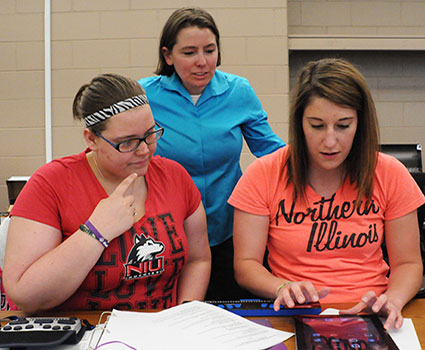
The Department of Special and Early Education cares about its graduate students, she says, and cultivates a culture of belonging and collaboration where all are seen, heard and acknowledged.
Her own students “come from all walks of life – people who have done some amazing things and are now looking for a change,” she says, and thanks to national outreach, weave a diverse fabric.
And, as part of the greater Huskie faculty, she is humbled and appreciative for the recognition from the Graduate School and her academic colleagues.
“I give a lot of credit to our faculty, because with these big, campus-wide awards, there’s someone behind them, and usually plural ‘someones,’ ” Kelly says. “There are faculty who have nominated people and put together these rigorous application packages, and then have often sat on these committees, and reviewed and thought and reflected on all the applicants, and not just the ones that they’ve put forward. It takes a village, and I think that shows.”
Mostly, however, Kelly is grateful.
“I get to teach. I get to research. I get to work with all of these great people, and I’m making a difference by recruiting people into this field,” she says. “It really doesn’t get any better than the situation I am in now here at NIU.”