
Exactly 12 hours later, the challenge to follow her example – and the fortitude, reflection, work and commitment that requires – was made plain.
Michael Manderino, one of the four camp counselors with James Cohen, Joseph Flynn and Dana Isawi, delivered a Wednesday morning plenary session full of questions.
Think about the mission, vision and values of your school and district. How are those being communicated? Are they stated explicitly in your curriculum? On the building edifice? On the main website? On individual teacher webpages?
What is implicit? How does it align, or not align, with concepts of diversity, equity and inclusion? What is hidden? What are we not talking about that’s actually driving policy, practice, pedagogy and assessment?
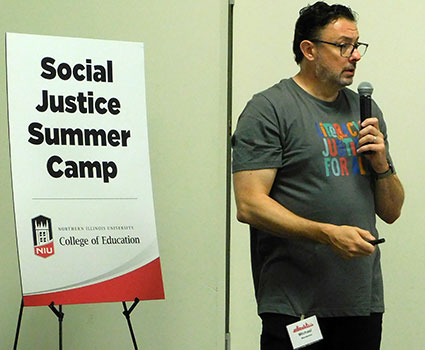
“How are reconciling some of those explicit, stated purposes for education that talk about freedom and liberation and self-discovery and the full human experience? How do we use that language in the structure of our schooling?” asked Manderino, an associate professor in the Department of Curriculum and Instruction.
“And then, how do we reconcile that with this ‘inequity by design’ – that hidden curriculum with the explicit curriculum? The hidden purposes of pedagogy vs. the explicit purposes of pedagogy?” he added. “And then, how do we start to engage in the work, or continue the work, of reconciling these differences, and then putting them on the table, rather than them just being unspoken?”
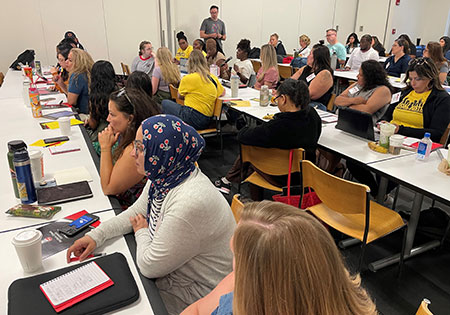
Manderino then encouraged his audience of K-12 educators, including teachers and administrators, to adopt a five-step plan of action when they encounter disparities.
Notice. Name. Interrupt. Dismantle. Rebuild.
“What is baked into the architecture of school that allows that hidden curriculum, pedagogy and assessment to continue despite the language of liberation and freedom and self? What are these systems in play in which our institutions are embedded?” Manderino asked.
Compliance? Control? Coercion? Whiteness? Heteronormativity?
“As we look at these juxtapositions of stated purposes of education as being positively oriented, and legislation that is stripping rights away from people, and humanity from people, what do we notice about the in-between? That’s maybe where some of those ‘hidden’ purposes start to come out,” he said.
“Over the day, I hope that you start to think, ‘What is my alignment in terms of the purposes of education for my students?’ There are things we can control, things we’re concerned about and things that are out of our control,” he added, “but our classrooms – our spaces within the school, whatever they are – are what we can control. And I think that starts by being able to live our purposes out loud, to state that explicitly and to say why.”
IF THAT WASN’T LOUD ENOUGH, the volume soon soared.
Six students of color from DeKalb High School sat front and center for a panel discussion where they discussed “their truth” with the teachers, some of whom already knew the teens.
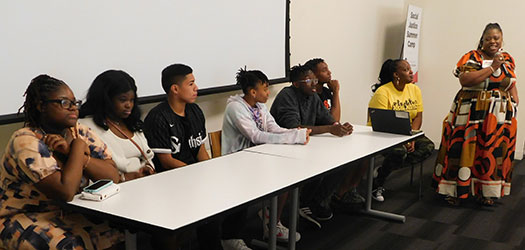
With permission to speak freely, the panelists did just that – including an honest declaration from one that she sometimes feels that teachers don’t truly care about students of color. If so, she said, foreign language classes might include Swahili and not just French, German and Spanish.
Moderator Amonaquenette Parker, director of Diversity, Equity and Inclusion for DeKalb Community Unit School District 428, suddenly found herself speaking for the audience.
“That hit. That hit hard. ‘It seem like you don’t care.’ Wow. That hit my heart,” Parker told her “babies” at the dais. “I’m sorry that it seems like we don’t care. I am.”
Parker’s questions elicited several unvarnished responses.
Among them:
What is one thing that you wish all your teachers and school leaders understood about you and, specifically, as a student of color?
- You don’t have to dumb down the question just because I’m Black.
Do you feel that your curriculum reflects your culture and history?
- I asked my teacher during Black History Month, ‘Why are we only learning about slave trade and Barack Obama and stuff?’ And then she said I was disrupting the class and kicked me out.
- I feel like we should get to know more people in Black history besides Martin Luther King Jr. and Rosa Parks. There are more people who have done more for this world than just this specific group of people that our teachers are told to teach us about.
- Whenever they talk about slaves, everyone in the class turns their heads to look at you – like you were a slave.
Have you experienced or observed any disciplinary practices you feel are unbiased or unfair?
- I understand that there’s a level of respect because you are my elder, but when you say something, and it’s backhanded, such as a microaggression, or it has some rooted animosity toward me because I am Black student, and you feel as though I should not have a voice, then we have an issue, because that’s when you try to take away my voice, and my voice is something I love to use. I will use my voice in any, and every, moment if I can.
Workshops offered Wednesday and Thursday covered such topics as creating social justice videos; writing as healing for students experiencing toxic stress and trauma; disrupting the monolingual bias; countering colorblind and color-evasive policies and practices; supporting refugees and undocumented immigrants; hip-hop and counter-storytelling in the classroom; and whether antiracism is necessary in K-12 schools.
Keynote speakers included Bess Wilson, chair of the NIU Department of Special and Early Education, and Tambra Jackson, dean and professor of the School of Education at Indiana University Indianapolis.
Films shown for nighttime conversation were “1619” and “The Other Side of Immigration.”
Closing activities Friday included district-level discussions and planning.
Every component of the busy agenda bolstered a guiding purpose, said Flynn, professor of curriculum and instruction.
“The No. 1 theme we promoted this summer was humanity – embracing and engaging the humanity of all students who are in their charge,” Flynn said.
“Hopefully, the camp this year inspired all of our teachers, through the various stories and lectures and presentations that they heard, to be more engaged with their students and to recognize that, behind all the numbers and statistics and grades, it’s a child that you’re dealing with,” he added.
“And children, no matter who they are, or where they’re from, or what we may think they are or are not going through, all deserve to be treated with respect, dignity, fairness and love. Humanity is where it’s at.”
