

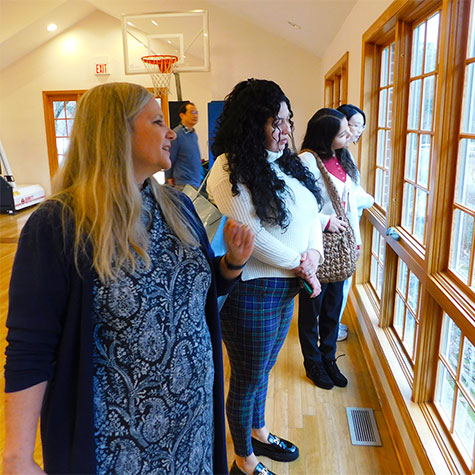
Carolyn Kambich winds her way through a group of NIU College of Education visitors at Riverwoods Montessori Elementary School to announce that an impromptu piano performance is taking place just down the hall.
Sure enough, a young girl – maybe in fourth-grade, Kambich guesses – is casually and expertly playing from memory a classical sonata on the upright, her fingers dancing fluidly across the keys at a level that seems professional while her friend stands next to the bench and watches.
While this might seem unexpected in another school, it’s par for the course at one of three North Shore Montessori Schools founded in 1966 by Kambich and her husband, Tony.
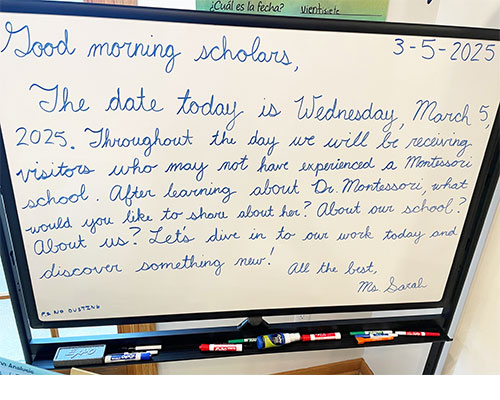
And witnessing something like that was exactly the point March 5 for the 13 Early Childhood Education majors who spent the day observing the students and teachers while also learning about the Montessori philosophy and curriculum.
Tony and Carolyn Kambich are proud NIU College of Education alumni, classes of 1959 and 1960 respectively, who opened their first school in Deerfield. Their daughter, Lisa, currently serves as director of schools, overseeing operations at all three buildings, which also includes the Northfield/Glenview location opened in 1991.
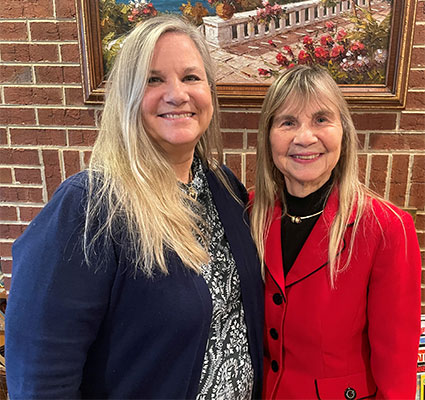
Lisa Kambich was happy to host the Huskies on the Educate Local trip: “I’m excited to be with future teachers who are passionate about this work.”
“When you have people who are really interested in making a difference in the world – and that’s what we do when we’re working with children – then I’m excited to have people studying and already on this path,” she says, “and I love for them to be able to come and see a little bit about how Montessori is also on this path, and to discover more.”
Kambich knows personally how Montessori transforms students.
Not only is she among the graduates of the Deerfield school, established when her parents and others in their community wanted to provide a Montessori program for “their own children and generations of children to come,” but she also is a 30-year employee of North Shore and the mother of Montessori alumni.
First, she says, “I know what it feels like to be a child experiencing this.”
“Montessori is a joyful way of learning, and it’s a natural way of learning, so when you’re tapping into something that’s very natural and joyful, and it’s coming from within, you want more of it,” she adds. “When we talk about lifelong learning, it’s not just that phrase – ‘lifelong learning’ – it’s part of who you are and how you live. If you watch the children here, you see it. Every day is really a great day of discovery.”
 Second, she adds, “I took the Montessori birth-to-3 training before I had my own children, and that was just so that I could understand development more specifically at that age, and it really changed the way I parented.”
“When I look at my own children, who had the benefit of this education, and I see the people they are today – very happy in themselves and very successful in their lives, in many different aspects, because we can define success in many ways – I see them as successful human beings having good relationships with others, making a difference in the work that they do and using their talents in this world,” Kambich says.
“Having worked with hundreds and hundreds of children, and seeing second generations coming through, and seeing the people they become and what they do with their lives – that’s what our education is about. I see how well it works, and it’s great to be a part of it.”
MICHELLE SANDS, an assistant professor in the Department of Special and Early Education, and Myoung Jung, an associate professor, accompanied the Huskies to Riverwoods.
Both wanted the future teachers to glimpse a different philosophy of early childhood education in action, especially one that’s not as common.
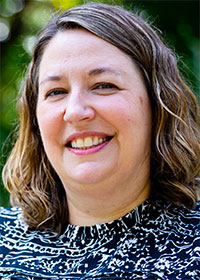
“Part of what I love about our program is that we try to support our students’ understanding of not only what they themselves have probably experienced but also what is also possible,” Sands says. “I think these experiences provide an opportunity to build on their feeling of community and being part of something bigger.”
According to “Montessori’s Integrated Spiral Curriculum,” an essay written by Montessori Foundation President Tim Seldin, Maria Montessori “argues that learning can, and should, be a relaxed, comfortable, natural process.”
Doing so can prompt students to actively engage in their own development, the essay stated, and “lead students to think for themselves.”
“The secret is to pay attention to the hidden nature of the child at a given stage of development, and to design an environment at home and school in which they will begin to fulfill their innate human potential,” Seldin wrote.
“Montessori observed that when children grow up in an environment that is intellectually and artistically alive, warm and encouraging, they will spontaneously ask questions, investigate, create and explore new ideas,” the essay continued. “She found that children, especially when they are very young, are actually quite capable of absorbing information, concepts and skills from their surroundings and peers, almost through osmosis.”
What that means for teachers, he wrote, is to not “simply teach children basic skills and information. In addition to becoming culturally literate, children need to learn to trust their own ability to think and solve problems independently. Montessori encourages students to their own research, analyze what they have found and come to their own conclusions.”
Students absorb knowledge in myriad ways and at myriad rates.
Mistakes are OK – “Like the rest of us, children tend to learn through trial, error and discovery,” Seldin wrote – and “learning becomes its own reward, and each success fuels a desire to discover even more.”
Indeed, watching the children in a multi-age classroom at Riverwoods revealed that most were working on projects by themselves. Their teacher paid visits to ask questions – and, frequently, to answer their questions to her with more questions.
When that teacher was ready to lead a conversation about the family tree of invertebrates, she asked one boy if he would come to the rug with the others. “What is the lesson?” he asked – and, hearing her answer, chose to continue with his own activity and was given permission to do so.
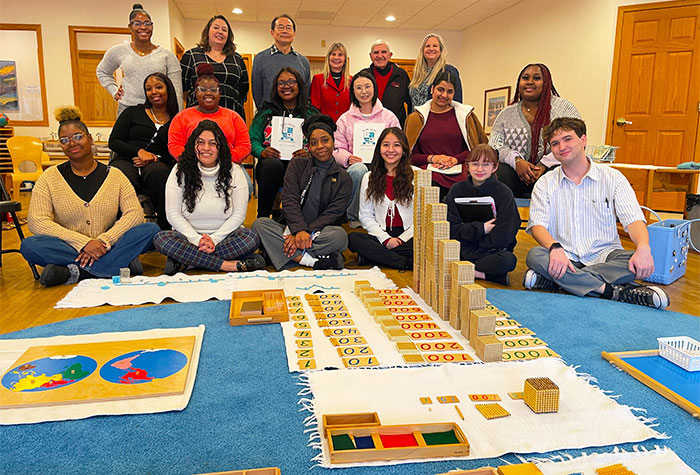
At Montessori, Lisa Kambich says, teachers prepare the environment, set the routine and allow children freedom of choice and agency, including permission to engage in self-organization and socialization.
Walls are mostly bare. Children are not discouraged from daydreaming if they peer through the windows at the nature outside. Yoga mats and balance boards are available for seating if desired.
“Jobs” are available for children throughout the school; adults demonstrate the tasks at first but soon pivot to, “Show me how well you can do it. I know you know how to do it.”
In the classroom, where “nothing is accidental” but always “intentional” to “give students just what they need and just when they need it,” teachers guide children to realize that “knowledge is everywhere” and to “use your resources” and “ask your peers” when they have questions – and “to collaborate. They will lift each other higher and remove the obstacles.”
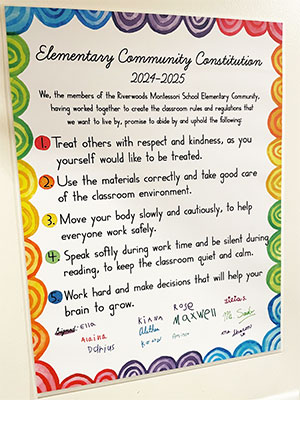 “Sharing comes naturally from within,” Carolyn Kambich says, “instead of forced artificially from without.”
Academic materials are arranged from left to right, and from top to bottom, in increasing difficulty to align “with that sense of order that the child is developing within.”
That flow – that interconnectedness – is not explicitly revealed to students. Rather, “they discover it” – along with perseverance and problem-solving skills.
Permeating every square inch indoors and out, Kambich says, is “respect” for the young students. “They’re used to being treated as a person,” she told the NIU visitors, “not as an adult to a child, but as a person.”
“The inner light of the child shines forth as he or she lives each day in the peaceful Montessori community,” according to a brochure from Riverwoods, one of the only a few schools in Illinois accredited by the American Montessori Society. “Children discover who they are and begin to find their unique places in the world. In this way, the joy of life is expressed in each child, and our world is all the better for it.”
NIU’S SANDS HEARD POSITIVE responses regarding the trip along with comments from many about “how different it looked” from their clinical placements.
“I always tell my students that we’re welcoming them into the broader field of education and early childhood education, and I think that this allowed for them to see what being ‘a teacher’ can look like in various places,” she says.
“What’s more exciting to me are the conversations we had in the afternoon that were about what they could do in classrooms where they might be in the future, even if they’re not Montessori programs,” she adds. “They really enjoyed how calm and peaceful the classrooms were, and they really enjoyed learning about how the philosophy is very much about supporting children’s understanding of creating a peaceful environment and their ability to engage in peaceful ways.”


Arielle Taylor, a senior from Robbins who will graduate this fall, says she “learned so much just by being here and observing.”
“I’ve always wanted to be a teacher, since I was a little girl. I just really care, and I think we need people who care,” Taylor says. “The start to students’ education is very important, and I also think that representation is very important.”
Her “main takeaway from today is just the independence, agency, respect and trust of the environment in this school,” she adds. “I think it will set up students really nicely in their futures. They will be independent, and they will be confident navigating experiences approaching adulthood.”
Cameron Doty agrees, calling Montessori “completely different than what I’ve ever seen anywhere else.”
“I’ve seen a lot of independence and a lot of respect for the children are at school here,” says Doty, a junior from Roscoe. “The confidence in these kids is phenomenal, and I can definitely see a difference in the approach in how it’s impacting these kids and their learning, and how they make friends and collaborate.”
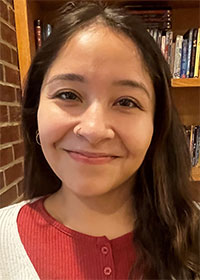
For Marissa Casillas, the impression was “how they let these kids really lead all the activities they do throughout the day” – and she already knows how she can model that no matter where she eventually teaches.
“It’s very much child-based and focused. They’re really making their own decisions, and the teachers are here to just guide them along the path, and that’s really cool to see,” says Casillas, a junior from Joliet. “I can make sure that I’m giving all the kids in my classroom this opportunity to have some independence and freedom.”
She was grateful to spend her day in Riverwoods.
“I’ve always really liked working with kids, and going into college, that was really the only thing I was sure of,” she says. “And, now that I’ve been in studying in this major at NIU, and in the field, it’s made me so much more sure.”
Mission accomplished, Sands says.
“Physically spending time observing a variety of methods is transformative for our students,” she says. “I want our NIU students to be able to have conversations with a wide variety of educators about these different philosophies, modes and methods, and I think this was a good opportunity for them to practice that.”
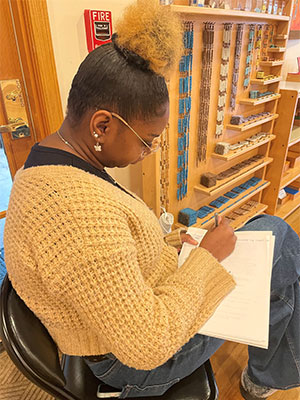
Reflection enables them to analyze why they teach the way they do, she says, along with how they might deliver future lessons and why they might have only witnessed only one instructional method in their own school lives and not others.
And now that their eyes are opened, she adds, “I think it makes them more flexible in their thinking and in their ability, when they’re thinking of a particular child who might have a different way of approaching a task, to say to themselves, ‘OK, maybe I can present this in a different way.”
“It benefits them not only in their classrooms when they’re creating their environments and coming up with the strategies they’re going to use,” Sands says, “but it also helps them to understand and appreciate that, when their students present a variety of different needs or learning styles, they have become more confident and feel more comfortable saying, ‘I can address this need in a different way.’ ”
THIS EDUCATE LOCAL VISIT began when Carolyn Kambich contacted Bess Wilson, chair of the Department of Special and Early Education.
“Carolyn reached out to our department chair and described how, in the past, we have provided this experience to our students,” Sands says, “and she wanted the opportunity to share the program with our students again.”
During a late-morning dialogue when Lisa Kambich probed the visitors for their initial reactions, the Huskies spoke of how they were struck to see the children moving freely through their classrooms and the building along with their mature levels of courtesy.
The Kambich family are great champions of NIU’s Early Childhood Education major, she says, “and are very passionate, obviously, about the Montessori approach.”
“We are so incredibly lucky to have not only Carolyn and Tony, but also Lisa, supporting our program and to be willing to provide our students with this rich experience. The fact that they opened their doors to us and took the time to really create a day where our students not only got the chance to learn about the Montessori methods and philosophy, but also were able to truly observe that, was priceless,” Sands says.
“They’ve also been very generous in providing our program with a variety of materials that can be used in a variety of classrooms,” she adds, “and that is invaluable because it allows our students to see a diversity of ways to support students’ learning and not just those created for traditional classrooms.”
For Lisa Kambich, the relationship is a labor of love.
“I hope that, as future teachers, these NIU students walked away continuing to be passionate about the work that they do,” Kambich says. “I hope that they will continue to observe all different methods of education, I hope that they’ll find the ones that resonate with them, become very good guides and to do good work in the world.”
