

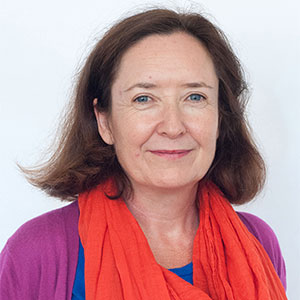
Megan J. Laverty remembers the moment when life delivered an unexpected turn.
She was a philosopher, working at the University of Melbourne in her native Australia and pursuing her Ph.D. in that exact field at the University of New South Wales.
“Everything was moving ahead smoothly,” Laverty says, “and then I attended an international workshop in philosophy for children. I got to see some fifth-grade students sitting in a circle, inquiring together about a philosophical question, and I thought to myself, ‘This is just something I want to be a part of. This is a wonderful thing.’ ”
Changed by that experience, she says, “I got interested in education, and thinking about the aims of education – what it is to teach, what it is to learn – and my trajectory shifted from that of a philosophy academic to someone who’s involved in thinking philosophically about education and bringing philosophy to educators.”
Laverty brought her mission – and herself – to the United States in 2000 to teach at Montclair State University. Five years later, she joined the faculty of Teachers College at Columbia University in New York, where she remains a professor of philosophy and education.
“It’s impacted my career in a number of ways,” she says. “It’s allowed me to work almost full time with teachers of all stripes, and I really love working with teachers. I really have such great admiration for what teachers do, and how important they are in the lives of young people – and how underappreciated they are.”
That last point applies to her as well, she says.
“Within the university, philosophy – traditional philosophy – has a pretty high status among the humanities and the sciences. It is thought to be a very demanding subject, and if you are a professor in that subject, people heed what you have to say and look up to you,” she says.
“Philosophy of education isn’t nearly so well regarded because education is not well regarded,” she adds, “so part of my professional life has been about advocating for education and educators within the university because we’re yet to fully appreciate it in the ways we appreciate the traditional humanities and the sciences.”
Named the 2024 recipient of NIU’s James and Helen Merritt Distinguished Service Award for Contributions to Philosophy of Education, Laverty will speak at 4 p.m. Thursday, Oct. 10, in the Sky Room of the Holmes Student Center. A reception begins at 3:30 p.m.
Her talk on “Philosophy as Liberal Learning for Today’s Youth” is sponsored by the Department of Leadership, Educational Psychology and Foundations to spotlight scholars who have deeply influenced educational thought and practice.
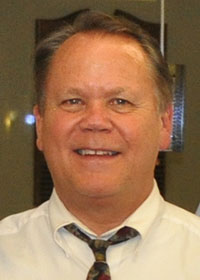
Kerry Burch, professor of Foundations of Education, believes that Laverty’s talk will inform and inspire future teachers.
“Dr. Laverty is one of the nation’s foremost experts on the ‘philosophy for children’ movement, and we wanted to choose someone for our yearly Merritt award who would appeal to the large number of elementary education majors enrolled in the NIU College of Education,” Burch says. “What we’re looking forward to learning from her is how, exactly, a seemingly exotic subject like ‘philosophy’ is actually quite a natural fit for all elementary education teachers once it’s framed as both the love of wisdom and the spirit of questioning.”
Questioning? Laverty clearly has that spirit.
“Another way my professional life has been impacted is that it’s really compelled me to adapt in my own thinking a lot more than I would have had to do had I remained a traditional philosopher,” she says.
“Education is always responding to changes that we’re undergoing as a society as a culture, and I think that if you’re going to speak to educators, you have to be speaking to those changes,” she adds.
“You always have to think about what’s going on and how it impacts everyone involved in schools – young people, teachers, administrators – and I often find myself thinking about things I never imagined I’d be thinking about, and sometimes not thinking about them well, because they’re new and they require lots of skills and information.”
But those teachers who do ponder their craft will benefit, Laverty says, especially when they nurture conversations between students and ensure that all viewpoints and experiences are taken seriously and given the same consideration.
“There is a lot of anxiety at first because it requires them to let go of their position as teacher – the font of information; the authority figure in the classroom; the person who’s going to inform, advise and direct,” she says, “because within the context of philosophical inquiry, the commitment is to an egalitarian spirit where we all come together with respect to these questions. What is friendship? What is real? How do we know what we know? What is it to lead a good human life?”
After a while, however, “the teachers say they really appreciate it because it’s an opportunity for them to really hear their students, and they don’t often get to hear their students because they’re only listening for an answer.”
“It’s also an opportunity for them to appreciate the existential depth that their students have and the kind of wisdom that students themselves bring to life,” Laverty says.
“Sometimes in education, I think that we get so caught up with thinking about what children don’t know, or need to know, or need to learn, that we forget that they actually bring a lot to the table,” she adds, “and we rarely give them a chance to explore their own wisdom, their own existential questions and their own philosophy, and this is an opportunity to do that.”
 Children, of course, also benefit.
“It acknowledges children in a different way. It says to children, ‘You, too, are part of this human conversation. You, too, are part of this community. Your perspectives matter as much as anyone else’s.’ We want to cultivate that from a very early age,” Laverty says.
“Our commitment to these traditions that we’ve been practicing for a very long time throughout history is also to recognize the beauty of the children being so young that it opens the possibility for innovation,” she adds, “because innovation has to come from a certain foundation or practice and, if we start young enough, there might be possibilities in a liberal education for innovation for future generations. I’m obviously very excited by that thought.”
All are welcome to attend the Oct. 10 lecture. For more information, email ktburch@niu.edu.
