
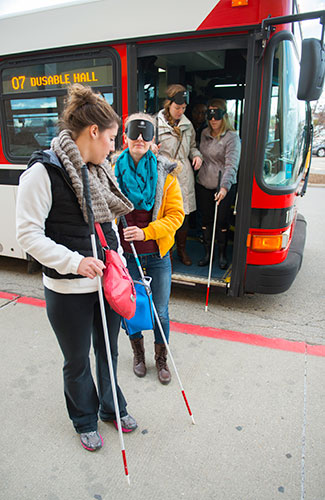
Eighty NIU students have gained a vivid understanding of the lives of people who are blind or visually disabled, thanks to a new course in the Department of Special and Early Education.
SEVI 205/505: The Blindness Experience, an eight-week, 3-credit and asynchronous online course open to students of any major or graduate program, debuted this spring. Undergraduates who successfully complete the class meet NIU’s General Education requirements in Society and Culture and in Human Diversity.
Topics include reading braille, guide dogs, the ocular system, assistive technology and representations of visual disabilities in media, such as the recent Netflix miniseries “All the Light We Cannot See.”
Interview-based voices of people who are blind or visually disabled infuse authenticity and first-person perspectives into the curriculum, which asks students to reflect on lives different than their own.
And, even the course was fully online, students were required to come in person before the first session to pick up folders stuffed with fun items such as the braille alphabet, a braille version of the Weekly Reader, tactile smiley faces and even their names written in braille.
However, says Professor Stacy Kelly, the greatest reward is added knowledge and skills along with a glimpse into a booming career path still unknown to many.
“Our favorite topic is the grand finale – Module 8 of eight modules – on how to become a vision major at NIU,” Kelly says, “and on the need for people to consider this profession: ‘If not you, who do you know in your life with whom could you share this?’ This is actually a field that exists. We are a hidden gem. People don’t know about us, but once they find out about us, it’s like, ‘Wow, this could really work for me or someone I know.’ It’s about spreading the word.”
Kelly and instructor Sue Dalton developed the course on one offered at Florida State University.
“Five or six years ago, I was at a board meeting in our field, collaborating with folks, and one of the university programs was talking about this class they offer and how it’s the most popular course on campus,” Kelly says, “and I was like, ‘Say what?’ So, we talked, and I was like, ‘We can do that at NIU.’ This is a class for everybody, no matter what you want to be when you grow up. It hits all the marks of a class for the masses.”
Returning to DeKalb, Kelly and Dalton determinedly pushed their plan through all curricular channels and into the catalog just in time for COVID-19, which promptly stalled all momentum. The course remained on paper only until the arrival of a new department chair and, with that, talk about new visions and new initiatives.

“I mentioned it in the fall and said it was time – it was definitely time,” Kelly says.
“We launched this spring, and it’s been so well-received. It just took off like wildfire. It already was filling up between the halfway point of the semester, and we had to open another section,” she adds. “I think that people in general might have seen ‘Blindness Experience’ and have been curious.”
Acting Dean Bill Pitney requested the second-half-of-semester, eight-week schedule, Kelly says, calling that move “genius. It met a need for students who had to drop a class for whatever reason but also had to maintain that full-time or part-time status with us.”
Second-year graduate student Toyo Afolabi, who came to NIU from Lagos, Nigeria to pursue her Master of Public Health degree, can confirm Kelly’s hunch.
“I was initially drawn to this course because of its name, ‘The Blindness Experience,’ ” she says. “To me, the name reflected something just beyond academics; it was an amazing experience to learn more about people who are visually impaired and the role that I can play in being an advocate for easy accessibility for them within society.”
Afolabi “learned so many amazing things” that she struggles to rank them but will put braille on the top.
“This is one of the best classes that I have taken since coming to NIU,” she says. “Before now, I never understood how reading with braille works, but I now comprehend the basic fundamentals of braille. I believe that I can communicate better with someone visually impaired now via writing and reading.”
Meanwhile, as someone in the health profession, “I now feel more confident in providing care and support for people who are blind or with low vision. I also feel better positioned and more knowledgeable in being an advocate for easy accessibility across the nation for them. The knowledge from this class will also help shape my experience as I advocate for equal access to health care in general.”
Destinee Garcia, a senior sociology major with an emphasis in criminology, enjoyed the course and especially its braille components.
“Something that interested me always was the ability to see and understand the values of what people with a visual impairment have gone through or are going through but also the ability to understand things through their perspective and learning new ways of thinking,” says Garcia, who is from Chicago.
“How I can use this in my career is in the ability of wanting to help others,” she adds, “but also the ability to help and understand more of what a person with a visual impairment may be going through and lending a helping hand.”
Those words are music to Kelly’s ears.
“Our students have a little more insight. By no means are they trained experts yet – and we’re not giving them that impression – but we’re letting them dabble in this profession and see that there’s this whole world out there of making things accessible and meaningful to people who are visually impaired,” she says.
“If they’re in a health care pathway, and when they enter a room to care for a patient who’s visually impaired, maybe they’ll have some awareness to announce their presence,” she adds. “If they’re going into some sort of high-tech career, and when they consider the technology they’re developing, and what if their consumers can’t see, maybe this will change the way they develop that technology.”
Moreover, she says, “it’s all about collaboration. No one is meant to take this on alone. Maybe these future health care providers and future tech experts now will have some idea about the visual disabilities field as a profession where there are people they can reach out to for support, knowledge and expertise.”
Looking ahead to the fall, Kelly says that the “real dream is to find a few students who follow up with us to learn about the generous financial aid we have available to enroll in our program.”
