
 What began in Naperville Community Unit School District 203 could not stop there.
Faculty from the Department of Educational Technology, Research and Assessment interacted with around 200 students in 2021 and 2022 to observe how working with LEGO educational robots might stimulate the problem-solving and computational thinking skills of third- and fourth-graders.
But NIU’s team hungered to know more.
“We came up with a really good idea of how to improve the teaching, especially what concerns scaffolding, and we wanted to see whether it worked,” says Michael Tscholl, a research associate professor. “We also wanted to work with schools that draw on underrepresented communities.”
That opportunity proved available through cross-campus collaboration with the Division of Outreach, Engagement and Regional Development.

NIU STEAM has delivered STEAM activities for the past three summers in Dolton West School District 148, where 97.3% of students are considered low-income – and, in June, Tscholl, Associate Professor Ying Xie and Graduate Assistant Stella Jung carried out Part Two.
Kristin Brynteson, director of NIU STEAM, invited the researchers to participate within the NIU STEAM summer program for fourth- and fifth-graders from Lincoln, Roosevelt and Washington elementary schools who participated in the four-week summer programming for three days each week.
Each school hosted its own program that included three hours of STEAM activities one day a week per grade level.
“I had talked to Ying and Michael before about the work that they were doing with elementary kids and robotics,” Brynteson says. “I really liked that the kids would be able to get hands-on experience with the robots. It seemed like a perfect fit for our summer program with the Dolton program.”
Xie shared that excitement.
She had helped to design the earlier Naperville curriculum: Two separate studies were conducted there – a quasi-experimental study with 200 children and a qualitative study with six students – to examine more in depth how they learn and which challenges they experience. Xie was then eager to improve those lessons based on findings from the smaller examination.

“We found the students were having a lot of trouble understanding how robots work. They have misconceptions, and if they had had no exposure to robots, they didn’t know how to program them,” Xie says, “so we started each day with some explicit instructions about how programming should be done. Where to start? How to start? How do sensors work? How to move the wheel? How to control the motor?”
Meanwhile, Xie adds, “another thing we found was that they were not able to understand the ‘nested loop.”
“Previous research has found that students, especially of this age, can do sequential programming. They all have experience getting up, brushing teeth, putting on clothes; they can all do that,” she says. “But when they’re faced with ‘nested’ design – a loop within a loop, or a loop within a condition, or a condition within a loop – they are totally lost.”
In Dolton, the team’s solution was to use “unplugged” activities such as exercises using pencil-and-paper.
An example are worksheets with four-by-four square grids with a starting location and goal; students were challenged to map a successful route through the box to reach the goal.
They had to write their own word-based and arrow-based algorithms to navigate grids with open paths and blockades. After a few of those exercises, they then had to determine if they could make the task simpler.

Another “unplugged” activity designed to teach simple conditions and “conditions within conditions” separated students into two teams.
Shown a series of red and blue cards, they manually recorded points awarded their team and points awarded to the other team, depending on the color (the condition). Then, to make it more difficult, the students had to determine whether the numbers on the cards meant awarding points to their team or to the other.
“Younger kids can’t think abstractly very easily because of their developmental level, but when they have tangible material in front of them, they can understand better – and because their robot moves as they programmed, they can make that connection,” Jung says.
“We wanted to promote their computational thinking before they actually programmed the robot,” she adds. “We had instruction every morning where we explained what we were going to and which concept we were going to practice using the unplugged activity so they can practice.”
It also accomplished a more practical necessity, considering the age of the participants and the similarity of robots and toys.
“What we always see is this strong tendency to play, and that’s something you need to take into account. If you just give them a robot, then immediately they are going to play and you can lose them,” Tscholl says. “We wanted to prompt them to plan and reflect before they jumped into an activity and get them into that mindset. If you teach kids to think more systematically, they become better at programming. Programming requires first to write the instructions, then upload them to the robot; once they are uploaded, the robot executes them.”
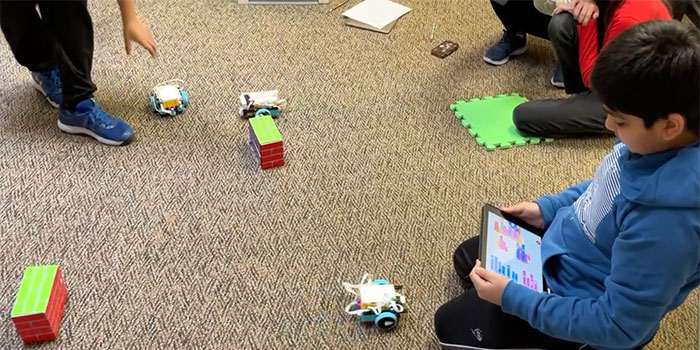
To test the impact of unplugged activities, the study used an experimental design with a control group. Students in that group were with a discussion of each day’s concepts but no unplugged activity before they programmed the robot.
And, Xie says, “we found the unplugged activity that was specially designed to train students for some specific computational thinking was very effective, so we want to let teachers know that if they want to teach computational thinking, especially in some areas where students are having difficulties, they can use our approach.”
 Doing so is vital, she adds.
“In the Information Age, I think computational thinking is kind of like a language. Information transformation is a way of how the technology world is organized,” Xie says, “and I think students really need to have this language in order to understand how things will operate in the future.”
“There is a broader significance to computational thinking, because it is also a form of problem-solving,” Jung adds, “so when we teach computational thinking to younger kids, they can get better problem-solving skills in their lives, not only for their academic fields but their other fields.”
“Students are really interested in robots because of the immediate feedback system. Students are so engaged when the robot demonstrates something they did on the computer,” Xie says.
“There is also a lot of research about humanoid robots that younger kids take on as their companion. They feel like, ‘Oh, I can have a conversation with the robot. I can even boss it around,’ ” she adds. “They also like creating a story and then letting the robot act out the story.”

Tscholl agrees.
“One thing that was really notable is that, when they understand how things work, it’s not just play. They get really excited and become creative, and we want them to have this intellectual experience of, ‘Oh, I know how this works, and now I can go further,’ ” Tscholl says.
“In fact, some of our designs weren’t able to accommodate their creativity. We saw that they ‘got it,’ and then they really wanted to do new things, and we were just scrambling. What are we going to do with them now?” he adds. “Those were really good observations.”
