
What is language? What are the roles of language and culture in the process of teaching and learning? How can teachers encourage motivation in their students during lessons covering those topics?
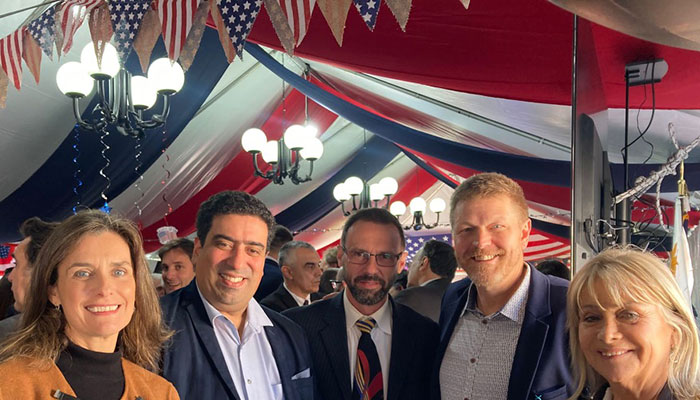
Stephen Tonks and David Nieto spent most of June and part of July in Uruguay delivering presentations on those concepts to teachers eager for that knowledge.
Tonks, professor in the Department of Leadership, Educational Psychology and Foundations, and Nieto, an associate professor in the Department of Curriculum and Instruction, made the trip as Fulbright Specialists.
More than 400 U.S. citizens receive Fulbright Specialists awards each year to share their expertise with host institutions abroad. Recipients are selected for their academic and professional achievement, demonstrated leadership in their fields and potential to foster long-term cooperation between institutions in the U.S. and other countries.
NIU College of Education doctoral alum Aldo Rodriguez, director of Políticas Lingüísticas,
was their host at the Administración Nacional de Educación Pública (National Administration of Public Education).
“Uruguayan teachers are well-versed in theory and methods, and they know a lot of theory and history of education and educational philosophies, but they’re always interested in learning more,” Tonks said. “Most of our presentations were engaging, participatory and interactive, and they were just very open and enthusiastic about learning.”

“All of them had great questions, too, and sometimes even additions to our presentations,” Nieto added. “It was really fun to present to them.”
Presentations were given to elementary teachers of Spanish and Portuguese, second-language teachers, school administrators, teacher-candidates and at CeRP del Norte, a college in Rivera. One presentation, held June 23 via Zoom, reached more than 300 participants.
Each detailed ideas, concepts and resources that teachers could implement immediately and, Nieto said, feedback at those workshops was grateful.
The NIU duo also met with school principals and their leadership teams, a university classs and an Armenian Language in Uruguay group. They also engaged in a conversation about language, culture and teaching with Armenian school teachers and principals.
Driving interest was Uruguay’s passion for language.
Residents there speak Spanish, Portuguese, English, Italian and several indigenous tongues, including Charrúa. Children also can learn languages such as Chinese, German and French, which Armenians already speak.
After George W. Bush visited Uruguay while he was president, leaders there were moved to put more resources behind forging a stronger relationship with the United States and toward instruction in English, the language of political power and diplomacy.
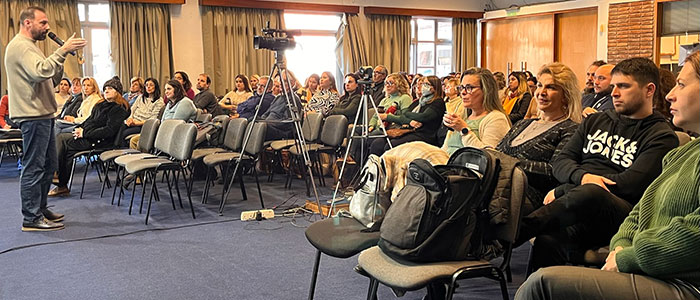
“They’re trying to build more second-language instruction, primarily English, into the younger grades,” Tonks said. “Even in rural schools – and they still have one-room schoolhouses where one teacher has all the grades together – they’re trying to get English there in a remote way through online means.”
Both came away with positive feelings for their counterparts in education.
“Whenever you go to a country that has fewer resources, it’s always impressive to see how much the teachers fight for the students. They were trying to find resources here and there to ensure that their students had access to a high-quality education, and that was really great to see,” Nieto said.
 Nieto also “was impressed with their approach to language education,” which he called visionary.
“Here in the United States, we’ve taken a restrictive approach to languages other than English,” he said. “Seeing a country that actually implements completely different policies – they encourage the learning of languages in school, and not just Spanish or English, but Italian, German, French and the native languages – I really enjoyed that.”
Tonks appreciated the willingness of the teachers to grow in their practice.
“Many teachers in Uruguay, just like teachers around the world and in the United States, still use a lot of extrinsic motivation in their classrooms when research shows that intrinsic motivation is better for learning in the long run for retention and for creating a sense of belonging,” said Tonks, the college’s faculty coordinator of Global Programs.
“Our hope is that they’ll be interested enough to implement some things slowly to just decrease some of the extrinsic motivation they use and to increase supports for intrinsic motivation,” he added. “I think we got a really good response. They’ve been exposed to something new, and that’s a good start.”