
 Some faculty in the Department of Educational Technology, Research and Assessment (ETRA) were busy this summer writing about robots – and children.
Can children program robots to sort differently sized objects for recycling?
Can they write code for robots to simulate an earthquake? Can they build robotic cars with sensors that react to environmental conditions and, therefore, navigate mazes?
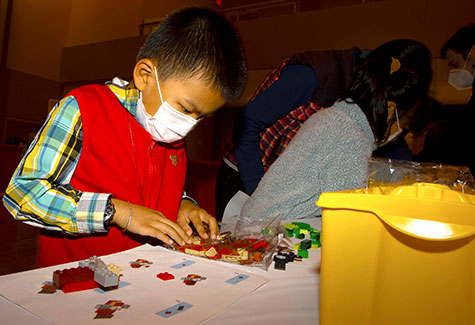
Data comes from several weeks of fall and winter observations in Naperville Community Unit School District 203, where around 600 students in second- through fourth-grade at eight schools participated in the projects to spark their problem-solving and computational thinking.
Researchers involved in the long-term project include Department Chair Wei-Chen Hung, Tom Smith, Michael Tscholl, Todd Reeves and Ying Xie.
Their partners in Naperville 203 were project managers Colleen Cannon-Ruffo and Kelly Talaga, both of whom are College of Education graduates.
Cannon-Ruffo, who now works for LEGO Education, essentially began the research as part of her NIU dissertation, “The Efficacy of Educational Robots in an Integrated STEM Curriculum.” The current study extends the concept and brings it “to scale,” says Smith, an NIU Distinguished Teaching Professor.
“What we’re looking at are activities oriented toward the Next Generation Science Standards and scientific inquiry,” Smith says.

“Kids are presented with a problem, and then they need to figure out how to solve this problem,” he adds. “It’s not so much reading and memorization. It’s working through the problem in particular. It’s working with a partner. It’s learning teamwork and how to do things together; to allocate tasks and to communicate.”
That process forms “the foundation of computational thinking,” says Tscholl, visiting associate professor in ETRA.
Meanwhile, he adds, the tasks presented to the Naperville students leveraged their existing skills in problem solving and inquiry-based learning to develop their computational thinking ability.
“A push toward computational thinking is all over education. That has meant several things, but probably the most important is to prepare students for the workplace because digital devices are continuing to be introduced into the workplace and also into how science and engineering is done in practice,” Tscholl says.
“It doesn’t necessarily mean programming, although programming is one way to teach anyone how to use digital devices. Generally, the idea is to understand how computers work,” he adds. “If you look at science and STEM, it’s becoming all digital. People need to know how to create data representations, how to analyze data and how to solve STEM problems using computational devices.”

Educators began advocating for such curriculum around 25 years ago, Tscholl says.
“There is an interesting assumption, which I think is largely correct, that computational thinking is more accessible to students, especially elementary and middle school student. Computational thinking is, for example, thinking in terms of input and output, and in terms of sequences of action,” he says.
“These ways of thinking are pervasive, even without formal instructions,” he adds, “so the early proponents of computational thinking would say that once you give kids the ability to work with digital devices, their creativity is going to explode.”

CANNON-RUFFO AND TALAGA SAW just that.
“We had an experience in one of the classes that was amazing,” Cannon-Ruffo says.
It took place in a fourth-grade classroom, she says, where students built a model of an autonomous vehicle that included sensors responsive to colors and objects in their path.
The goal was to meet the Next Generation Science Standard (NGSS) on “Waves and Their Applications in Technologies for Information Transfer.”
According to the NGSS website, “students who demonstrate understanding can develop a model of waves to describe patterns in terms of amplitude and wavelength and that waves can cause objects to move.”
“It’s really hard to experience waves – you can’t see them,” Cannon-Ruffo says.
“So they built the model, and they learned how to program the model to move forward and backward and to turn, and then to use sensors so that it can react to conditions within the environment that would then change behaviors,” she adds. “Sensors use sound waves and light waves to make decisions.”
Next came the testing.
“Their final challenge was to program the autonomous robot to go through a maze, and their criteria was they had to use at least one sensor,” she says. “They learned how sensors work and how waves can be used for information transfer by experiencing that through building a robot with sensors. It brought that whole concept to life for them.”
For two consecutive days, she says, the students set up their maze in the same spot on the classroom floor. They programmed the robots for the navigation chore. Everything went perfectly.
But then, on the third day, right in front of a SMART board, it didn’t.
“There had been no problems up until this day, and then on this day the robot didn’t work at all. It was just not working, and the kids were getting so frustrated, and the teacher was getting so frustrated. We’re all just sitting there trying to figure it out,” she says.
“And then all of us kind of said, ‘Wait a minute. What’s different from yesterday?’ – and we looked around and said, ‘The SMART board.’ The smartboard hadn’t been on the two previous days.”
So began a discussion with the students about why that might matter.
The answer, they determined together, was the light generated by the device.
“Light waves are now interfering with the ultrasonic sensor, which was basically messing up the signals,” Cannon-Ruffo says.
“Once we started having that conversation, we’re like, ‘Well, let’s turn the smartboard off and see what happens.’ And, sure enough, it worked fine,” she adds. “That’s when we realized that the day before and the previous days, the maze had been facing in the other direction, which meant the robot sensors were facing away from the SMART board, not toward them.”
 For the adults in the room, the “aha moment” proved thrilling.
“Think about the extension conversation we had related to waves and how waves can deal with interference! We were talking about how it was using the ultrasonic sensor, and how sound goes out in a cone, and how that cone was getting interrupted,” Cannon-Ruffo says.
“All of that came about as a result of this experiment. It wasn’t on the lesson plan. It was just one of those conversations that happens because of the technology they’re using, and it just blows us away.”
TALAGA AGREES.
“Children are born as digital natives now, so this is a way to use technology that’s meaningful and has a purpose behind it,” Talaga says.
“They’re used doing a lot with their devices, such as iPads or Chromebooks, but now they are the ones actually programming another piece of hardware to make something happen,” she adds. “I think it’s that curiosity about how things work that we’re able to capitalize on and then bring forward.”
Meanwhile, she says, students are “automatically engaged” by being asked to build something.
“Whether or not they’ve had experience with LEGOs specifically, they’ve had experience with building in some shape or form,” she says. “For them to be able to use their creativity in building helps the teachers by having students who really want to engage in the project and to then think more deeply about the concepts behind it.”
Beyond the scientific explorations, students developed teamworking skills – an intentional goal fostered by their teachers – and took ownership of their own learning.
 “We have masterful teachers here, making sure the teams were balanced. One of our teachers asked about the students’ experience with robotics and LEGOs, and then matched up students accordingly. There were good pairings,” Talaga says.
“One partnership was able to move at a very rapid pace to figure out how to program the robot, and the rest of the students needed a little bit of support,” she says. “They still moved ahead – we weren’t holding them back – but, without us asking, they wanted to share their knowledge and did it in a way where they were helping the other students in the class.”
That brought not only the curriculum but the social and emotional learning “to life,” she adds.
“To work with their partners, to be able to take turns, to be able to think creatively, to be able to process information verbally and then on the computer as well? That communication is an important part of the teamwork, and these are the kinds of processes that we saw that made me excited and proud.”
FUTURE ITERATIONS OF THE STUDY will raise the stakes and scaffold the learning, Smith and Tscholl say.
“Essentially, we will increase the focus on the computational thinking as problem solving and not so much as programming,” Tscholl says. “We definitely have observed that the students are incredibly persistent, which is good when you think that it’s a STEM subject. They try and try and try, and they don’t give up.”
Researchers also are planning “unplugged activities,” he adds.
 “With the problem-solving processes we are observing, we want to stabilize them,” he says, “but we also want to teach them new ones using, for example, pencil and paper so that we essentially can intervene on these abstract problem-solving processes directly. If you give kids six months to work on a programming task, they will bootstrap that process, and that is very valuable, but we have a short time available.”
Smith also hopes to capture more data on amount of focus the students demonstrate.
Instructions for building and programming the robots “didn’t look easy,” he says.
“I was really amazed at how well the kids did, and their engagement was one thing I wish we had a better measure of. They were engaged the whole time. They didn’t wander off, or start doing other things, or start goofing off. They were just on it, the whole time,” Smith says. “One of the things we’re looking for is to have this level of engagement in the quantitative data collection, where we do have so measures of their interest and curiosity.”
Next on the team’s agenda is to write and publish manuscripts, present at conferences and apply for additional financial support to continue their studies.
“The ultimate goal here really is to prepare a federally funded grant that will put this on a scale that might involve a longer period of time,” Smith says. “If we have substantial funding, then we can afford maybe an agreement with more classrooms and with better equipment. We’ll be targeting grant proposals again this summer and in late fall.”
More sounds good to Cannon-Ruffo and Talaga.
“When you’re teaching students about robots using robots, that is considered a ‘primary order use’ of robotics. We are focused on ‘second order uses’ of robots, when you’re using robotics to teach something else. In our case, it was science and scientific principles we wanted them to understand,” Cannon-Ruffo says.
“By hooking it to that familiar ‘toy,’ which essentially it is, we’re doing that through play. They’re learning through play, and I like to tell the kids that there’s a term that LEGO uses called ‘hard fun.’ They’re having fun but it’s not easy fun. It’s hard fun, and their brains are thinking all the time,” she adds. “When they get that this toy that they’re used to playing with, and then get it to move and do things, their excitement goes through the roof.”
