
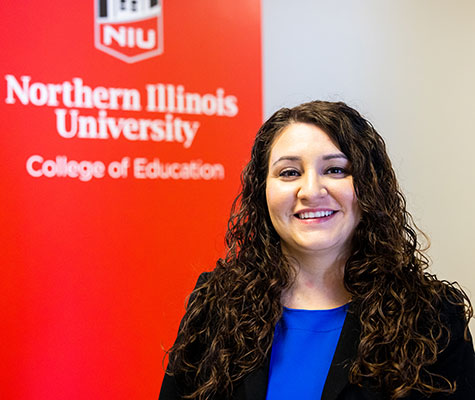
Yenitza Guzman wants to make the greatest impact possible in her calling to help others.
“As someone who has worked with underprivileged and diverse populations, I know that there is a lot of trauma out there. I know that there is a lot of hurt. I know that there are a lot of mental health concerns,” says Guzman, assistant professor in the Department of Counseling and Higher Education.
“What I also know is that the system that we find ourselves in is not really supportive of people who are not independently wealthy, and the large majority of our communities are not. They really need a lot of support,” she adds, “and I have found that I’m in a position now, after earning a Ph.D., to help train people who can go out there and help those people in need. I have the opportunity to make a larger change – because the world needs more counselors. The world needs more helpers.”
Believe this: She’s on it.
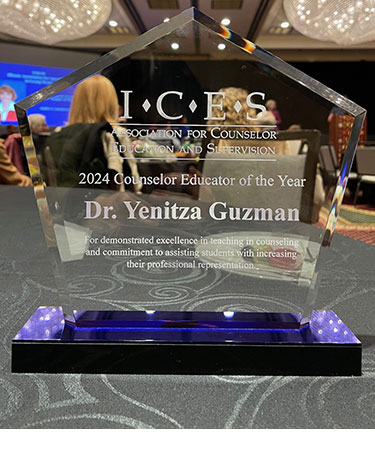
Guzman, who began her academic career only three years ago, is the 2024 recipient of the Illinois Counseling Association’s Counselor Educator of the Year award.
For the self-described “novice,” the recognition from colleagues and students remains a surprise.
“The positive things I heard were that I really jumped in and was very excited and eager. I had positive energy and was readily available to support counselors in training,” she says.
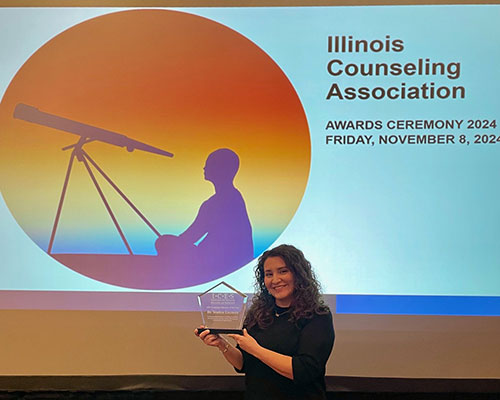
“My attitude is just to do the best I can. I focus on my students. I care a lot about them because I know what the profession is like,” she adds, “so it’s really a privilege to be able to pause for a second and reflect and just think that, ‘Oh, someone is acknowledging that I am trying. I am doing a good job. I do care.’ It’s such an honor and privilege to have someone say, ‘Good job.’ ”
Her approach to teaching corresponds with her dreams for her students.
“I hope that they are empathetic. I hope that they are culturally aware. I hope that they are supportive and able to create change and help their clients through very difficult challenges: When people are going to see counselors, it’s usually because there are some real struggles,” she says.
“So, in my classroom, I try to utilize the students’ voices as much as I can. I know that I have some years of experience, but I don’t think that I hold all the knowledge,” she adds. “My classroom isn’t a space where I’m lecturing for multiple hours. It’s really a space where I invite, and value, discussion and feedback. I want to make sure I’m providing a safe space for my students and that I’m modeling for them what I hope they will do to support others.”
 GUZMAN’S JOURNEY TO NIU’s classrooms began in the classrooms of the Chicago Public Schools, where she started her career as an English teacher and finished her decade there as a school counselor.
Working as a counselor prompted her to pursue a Ph.D., and once that doctoral coursework commenced, the opportunity to teach and mentor students in the master’s program led to a decision “to leave working as a practitioner and become a full-time faculty member.”
Call it a mission.
“Putting myself in a place to help create more counselors and to help create more helpers is really important to me because I know that there are a lot of people out there who, even through insurance, can’t afford counselors,” Guzman says.
Others with financial means might encounter ignorance, she says, or, worse, indifference.
“Because we can’t see the pain that some people have, we have people who don’t recognize it and don’t acknowledge it,” she says. “It’s not like when someone breaks their leg. It’s very visible. There’s a broken limb. They need to go find treatment. But when someone is anxious or depressed, you can’t see that – and so people tend to say, ‘They’ll get over it. It’s not a real issue. It’s not a real problem.’ ”
Most schools provide counselors, of course, and with that area of practice as her own launching ground, Guzman is aware of her power to mold school counselors-in-training.
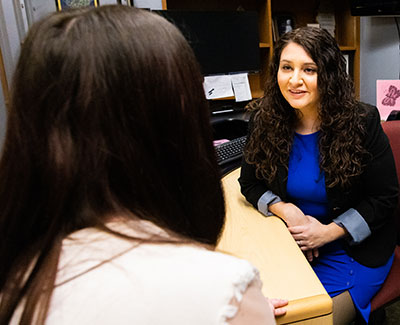
With that are many of those authentic examples she brings from her own time on the front lines and those others that she encourages students to share from their internships and practicums.
“School counseling is truly the core of my identity as a professional,” Guzman says.
“I talk a lot about the real-world application of what this will look like, and I do that intentionally because I think that what was missing in my own education was that everything felt very theoretical. Everything was by the textbook,” she says, “and I was able to learn from the textbook, but once I got into the profession, I wasn’t always 100% clear on how it translates. ‘What’s the real-world application to what I’m learning in the classroom?’ ”
Those bridges that she builds to span the gap from classroom lessons to career realities answer, she believes, the eternal question from students: Where am I ever going to use this? Why do I need to know this?
 And, she hopes, her teaching not only spreads awareness of mental health but also motivates future counselors “to fully support the whole person. That means we’re doing a good job.”
For her own part, Guzman finds motivation in the ICA award – “a call to action” that she retain her early-career excitement: “I don’t want to lose that,” she says.
“I want to keep the momentum going. I want to continue to love my work. I want to continue to feel passionate. I want to be able to help others feel joy with the work they’re planning on doing. I don’t want to lose that spark,” she says. “I don’t know what will come next, but I’m going to keep trying. I’m going to keep focusing on how to support my counselors-in-training.”
