
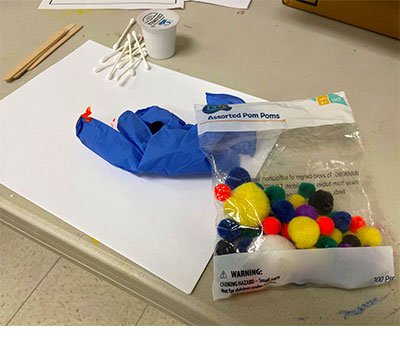
Plastic silverware. Wooden craft sticks. Pipe cleaners. Q-tips. Marble-sized pom poms.
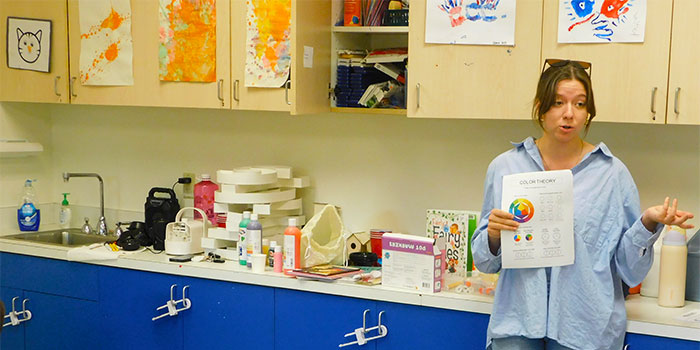
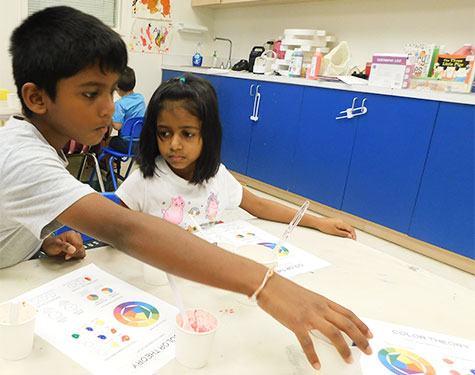
For children attending a July 31 summer camp at the Sycamore Public Library, these were the available – and intentional – substitutes for paintbrushes during an activity on color theory.
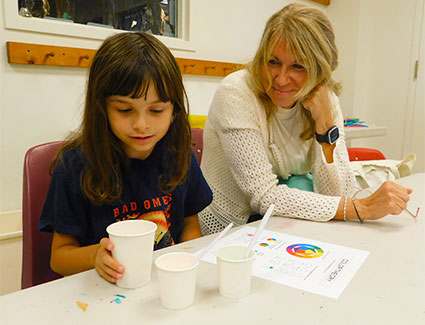
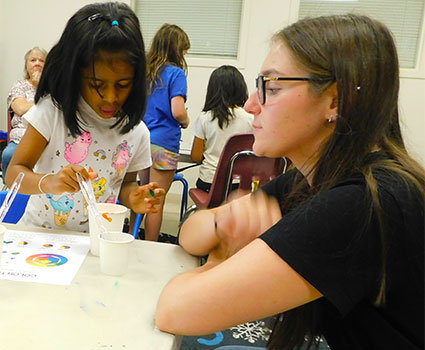
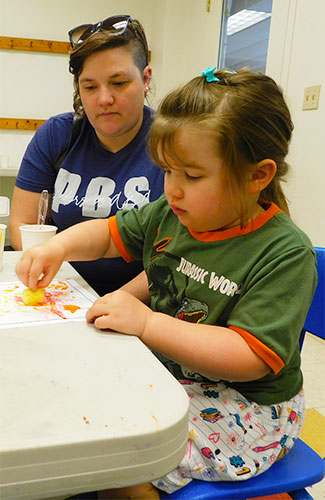
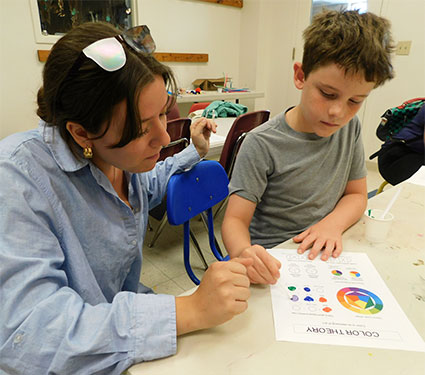
“Kids learned about primary colors, colors that are similar and opposite, and how you mix colors and what gets created,” says Kimberly Teal, a graduate assistant with the College of Education’s Morgridge Endowed Chair Office.
“We had them mix the paint themselves and had them use different materials to paint – there weren’t any paintbrushes – and we talked about how those materials influenced things.”
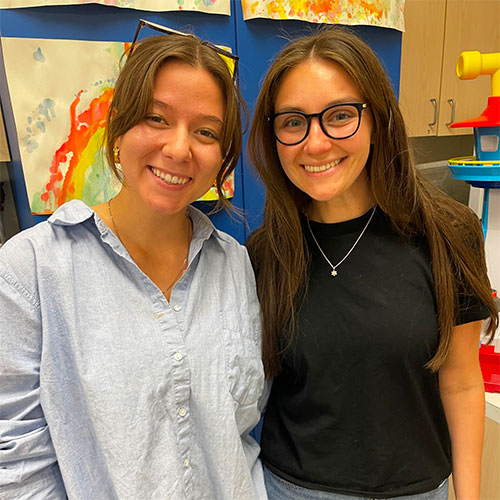
Teal and fellow graduate assistant Kristen Aragon, both of whom are speech-language pathology master’s students in the College of Health and Human Sciences, spent June and July delivering free, one-hour sessions of Camp Creativity to dozens of local children ages 4 to 9 who came to the Sycamore and DeKalb public libraries.
Camp Creativity was the product of their desire to continue working throughout the summer; their supervisor, Todd Gilson, the college’s associate dean of Research, Resources and Innovation, was on board – if they came up with an initiative, that is.
“So,” says Aragon, who is quick to credit Teal for spearheading the project, “we brainstormed some ideas. We had some ideas that kind of just went nowhere, but we liked our idea of doing a summer camp.”
“It’s stuff we’ve done before. We create lesson plans pretty frequently in our graduate program as speech-paths, so that made it easier,” Teal says, adding that “in high school, I worked at a day care, and my mom’s a teacher, so it was just looking up ideas and finding what would work and making something for us.”
Meanwhile, she adds, the pair also “wanted to do something for aspiring teachers to give them a chance to actually apply the skills they’re learning in class.”
“You can learn and learn and learn and learn, but I feel like the biggest thing is actually applying it and learning how people are going to respond and how an actual classroom might be,” Teal says. “So, in thinking about how to do that during the summer, a library felt like it made perfect sense because you’re going to have kids there.”
Next, the pair conceived lessons that would cover concepts of science, technology, engineering, arts and mathematics as well as storytelling.
 Those included constructing castles and towers made of marshmallows connected and supported by toothpicks – and, for the older children, tests of how their creations withstood simulated elements such as earthquakes, wind or weight – as well as an uber-popular unit on dinosaurs that including “excavating” prehistoric eggs.
Complementing the hands-on activities were PowerPoint presentations packed with information, read-alouds from books, conversations that dug deeper into the topics and, of course, questions for the children to ponder and answer.
“We made it engaging for them, and it was fun for them to learn about different career paths while doing these fun things,” Aragon says.
“We would say, ‘Who knows what an engineer is?’ – and we were kind of shocked when we did dinosaurs and asked, ‘Does anyone know what someone who works with dinosaurs is?’ They’re like, ‘Oh, a paleontologist!’ And we’re like, ‘You guys are so smart!’ It was so cool. I definitely didn’t know what paleontology was until I was a bit older.”
Gilson also was impressed by the results – and by Teal and Aragon as well.
“Working with both Kim and Kristen has really helped the Morgridge Office advance its mission in new and innovative ways,” Gilson says.
“One of the ways we’ve focused on enhancing the lifelong education of participants is through the launch of Camp Creativity,” he adds. “When Kim and Kristen brought me the idea, it was so different than anything I expected, but given their track record of accomplishment, I never questioned their ability to see this project through.”
BABATOLA AROGUNDADE is pursuing a Ph.D. in Counselor Education and Supervision from the Department of Counseling and Higher Education.
Like every student in the College of Education, Arogundade received an email from Teal and Aragon in search of adult helpers for Camp Creativity – an offer he couldn’t pass up.
“My academic career started with English literature. It really helped me with my writing skills and speaking skills and just made me grounded before I found passion in supporting people. I had always thought about that informally over the years, but then I realized that I could make this a career,” Arogundade says.
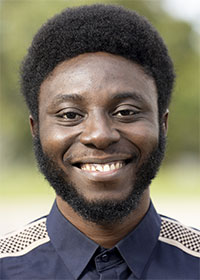
“I learned about mental health and I learned about how, when I support people, it makes me feel better as well,” he adds, “so that led me to studying guidance and counseling at the master’s level in Nigeria. Then I started practicing bit by bit and, over the years, I’ve worked in schools as a counselor. I work with a nonprofit organization as a mental health counselor in an HIV-AIDS setting and a psychiatric hospital.”
He’s also a court-appointed special advocate with CASA, an outgrowth of his enjoyment of working with children and teenagers in his professional practice.
“I love doing what’s called ‘Life Skills Workshop’ with children and adolescents, and I talk to them about self-esteem, assertiveness, decision-making, negotiation,” he says. “When I got the opportunity to do Camp Creativity, and I realized that it’s summer and it would let me gain more experience working with children, that’s why I got involved. I want to extend my skills.”
Mission accomplished.
“These kids might be young, but they have fantastic ideas,” Arogundade says.
“I allowed them to be creative. I tried not to get involved. I said, ‘Just be you.’ I always love for kids to ‘be you’ because I believe everyone has their own unique way of doing things, so I supervised and ensured that they felt comfortable,” he adds. “If there was anything they needed, maybe a question answered or support, I was always there.”
Arogundade learned as well.
“Because it was all about creativity, one thing I observed was patience,” he says.
“They were creating things that they cared about, and one thing about creating is that you have to think. I know that kids can sometimes be in a haste – they just want to rush things – but I realized that most of these kids were patient. They took it one step at a time,” he adds.
“That really stuck in my mind because it’s not just about the creativity activity. It’s about all the life experiences they will go through and the attitude they develop when they are at home or in the academic setting at school: patience and calmness. We gave them freedom, and they were still calm. They followed rules the way they were supposed to follow them. It was about obedience and that attitude of discipline.”
It reminded him of teaching college courses in his own graduate assistantship.
“I’ve always encouraged my students that, while we seek the A’s and the B’s, how you show up outside the classroom is also something,” Arogundade says. “The patience, the positive attitude – even when they struggle – and the willingness to learn that I noticed in these children will be beneficial to them afterward.”
He also gained a new outlook – “This was not counseling, so it helped me see kids from a different perspective,” he says – and reinforced an old one, thanks to his interactions with the Camp Creativity children.
“I grew up in a society where, when we give respect to who deserves it and to important people and to everybody around us, we make a better society,” he says.
“Society sometimes can be chaotic, and I believe that change begins with us,” he says, “so when you have an opportunity to make a change by teaching kids respect, discipline, being a better person and being themselves, that will make the world a better place.”
AROGUNDADE IS NOT ALONE in his appreciation of what Teal and Aragon delivered.
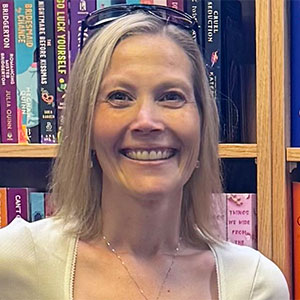
“The Sycamore Library was thrilled to partner with NIU for Camp Creativity,” says Lauren Manu, Youth and Teen Services manager.
“The NIU students provided a welcoming space where hands-on fun and meaningful literacy experiences flourished side by side,” she adds. “Through this collaboration, children strengthened their reading and storytelling skills, built confidence and discovered the joy of expressing themselves creatively.”
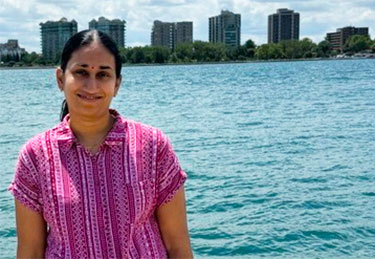
Devika Sampath, a functional systems analyst with NIU Registration and Records, brought her daughter, 6-year-old Sarah, to the Sycamore sessions.
“She is having a wonderful experience. She is having fun, and she is enjoying it. It includes thinking, knowledge and knowing how things work, and she is interested to come back,” Sampath says, watching Sarah paint.
“She is learning different things today, like how to use the materials and what are different color combinations,” she adds. “Last time, it was the illustration of a story and to make a character. She did painting and drawing, and painted her own story from the story that they thought out. She puts all her effort into this, and if she doesn’t know something, she asks people.”
For Teal and Aragon, all the kudos is great news.
Both were pleased to see how parents, grandparents and other caregivers jumped right in to help their campers with each session’s activities, something that provided a model for how they can keep the learning alive at home and to create their own educational projects.
“We had a lot of repeat participants coming through. They would come up to us and say, ‘Oh, we really love that you’re doing this.’ They were asking us, ‘When’s the next one?’ – and they started asking a little bit more about us and what we do,” Aragon says.
“When we mentioned that is something that we would like the future grad assistants to do, they really liked that aspect, too,” she adds. “We got a really good response rate from parents.”
Meanwhile, the pair enjoyed watching the campers make friends – “There are now kids who recognized each other, and will come in and sit by each other. Giving children that space in the summer to still be social is important,” Teal says – and build confidence in their STEAM skills.
“Kids are a lot smarter than I think we give them credit for. We’d give them an activity, and they’d be done in a second. That dinosaur activity? I made all these eggs, and they got through them within five minutes, had matched their dinosaurs and were creating environments from them,” Teal says.
“Some wanted us to be hands-on. They wanted to see an example of us doing the task. Some kids just needed to hear it, and they were gone,” she adds. “So, I think that pushing a kid is the most important thing. If you believe in them, they’re going to believe in themselves.”
Aragon agrees.
“It was important to give a supportive environment. Some of them were having more struggles and difficulties than other kids their age, so we made it more fun for them and we encouraged them, which I think was super helpful for them,” she says, “and it was nice for us to be able to learn, in trial and error, the best way to support different kids, different ages and the different ways of learning.”
The graduate assistants, who will continue to run Morgridge operations through December, also collected intel for their eventual successors should they choose to offer the camp again next summer.
“It’ll be nice for us to give this information along,” Aragon says, “to tell them what worked, what didn’t work and to say, ‘Keep doing this because it was so impactful to so many families,’ which I thought was really inspiring and fun.”
