
 In 2023, NIU’s Center for Innovative Teaching and Learning piloted a Curricular Innovation Grant Fund.
Congruent “with university goals and priorities,” the program was “established to provide competitive grants for experimenting with innovative teaching methods such as transdisciplinary learning, virtual reality, digital learning, active learning, inclusive teaching practices, open education resources or techniques introduced in the ACUE course on Effective Teaching Practices.”
Among the 20 inaugural recipients were two Department of Kinesiology and Physical Education faculty: Farah Ishaq and Zachary Wahl-Alexander.
So how did those Curricular Innovation projects impact all their classrooms? How did students respond? Has their teaching changed – and, if so, in what ways?
Farah Ishaq
• LESM 360: Sport Event and Facility Management
• LESM 560: Sport Facilities and Event Management

Farah Ishaq considers himself proficient in technology.
Blackboard? Yes. Videos? Of course. BenQ? Yes again. All good, Ishaq says, “but I wanted to take it a step above.”
Maybe, he thought, that next level was what Department of Kinesiology and Physical Education colleague Zach Wahl-Alexander was already doing: virtual reality.
And teaching courses in the management of stadiums, ballparks and sport arenas seemed a perfect fit.
“Virtual reality will provide opportunity for invaluable, near-practical simulations of facilities and event-related scenarios that students may find as future facility or event managers,” Ishaq wrote in his grant proposal, “while also providing more accessible opportunities like virtual facility tours.”
Ishaq attended a CITL workshop “that walked through different kinds of uses of VR in the classroom, which I found very helpful. It helps to have experience in these kinds of devices. They’re not always the easiest to use.”
He also heard that the learning curve is worth the effort.
 “It might be difficult to learn the actual device itself, but it’s valuable to take students out of the classroom,” he says. “There’s a lot of important learning that’s done in the classroom, but when you’re able to apply different aspects of virtual reality to these types of real-world scenarios, that puts students a step above in the experiences they’re having in the classroom.”
The Meta Quest headset not only allowed students to tour current facilities but opened doors to the past as well as to modern design movements that are shaping the future.
“A lot of times, we talk about the eight phases of facility construction, and when you’re talking about things that have already happened – some of these stadiums are the first to exist in the United States – we can’t really go back and see those in person. This is kind of the next-best option when we talk about exploring things that are part of history,” Ishaq says.
“One particular application I’ve used with virtual reality looks at trends in facilities and how they’ve changed since from the 1900s to where we’re at today, and a lot of those stadiums don’t exist anymore,” he says. “We now have the capability to see those – in the virtual world – which I think is super helpful to be engaged in history rather than just talking about it.”
Students responded well.

“They’ve grown up with technology,” he says, “and being able to incorporate the latest can, I think, be effective in the classroom because it gets students out of their seats. It gets them engaged in the material rather than just me saying, ‘Hey, get into groups and discuss this.’ It’s getting up, putting on these goggles and being able to look around.”
His own response was equally positive, he says.
“I like to be engaged in the classroom,” Ishaq says, “and this has opened my eyes to what else is out there in the teaching world and to thinking outside of the box when we talk about student engagement in the classroom.”
Zachary Wahl-Alexander
• KNPE 343: Elementary School Physical Education Methods and Field Experience
• KNPE 344/544: Field Experience in the Elementary School
• KNPE 449: Current Issues in Physical Education and Sport
• KNPE 479/579: Field Experience in Secondary Physical Education

Zachary Wahl-Alexander’s work with virtual reality already had made headlines.
Wahl-Alexander accepted the university’s invitation to teach in the metaverse, which came complete with the construction of virtual reality “twins” of an Anderson classroom and gym.
“I was approached because, in the past, I’ve done some research looking at using virtual reality (VR) to prepare the preservice teachers,” says Wahl-Alexander, who almost turned down the offer. “The more I thought about it, I realized this could be just a really cool opportunity.”
Powered by VictoryXR technology, Meta’s “metaversities” replicate college campuses with virtual grounds, building exteriors and interiors “fully ready for large groups of students ready to learn with their professor and other students.”
Two years later, Wahl-Alexander describes that KNPE 343 experiment “fairly successful” as well as “somewhat of a work in progress.”
He applied for the CITL grant to expand his digital expedition through “developing a 360-degree video bank of experienced preservice teachers and experienced teachers providing high-quality physical education instruction” to incorporate into several of his courses.
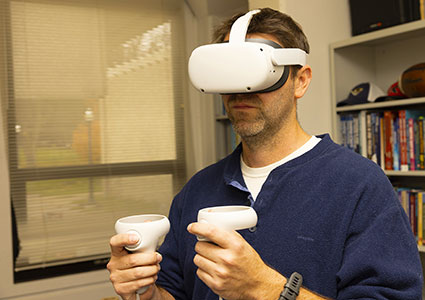
“My proposal is to create a video bank of expert/experienced physical education teachers from a diverse background, teaching a diverse variety of student populations. Taking this a step further, I will record a variety of content (e.g., isolated skills, sports, fitness activities), being taught using an assortment of pedagogical models and teaching styles,” he wrote.
“I will have the ability to integrate this technology into lectures and assignments focused on a wide range of skills (i.e., behavior management, effective teaching practices, content),” he continued. “Finally, as time progresses, I can incorporate my own students filming their own teaching and using the VR footage to conduct extremely thoughtful reflections. Not only is this novel, but there are significant scholarly implications.”
Among the benefits of virtual reality, Wahl-Alexnader says, is an immersive preview of what teaching in genuine practice rather than classroom theory.
Consider it the difference between football drills and scrimmages, he says: “When you have actual students in there, it just makes everything more challenging,” Wahl-Alexander says, “so the more you can replicate that, the better.”
Videos of current P.E. teachers provide another layer.
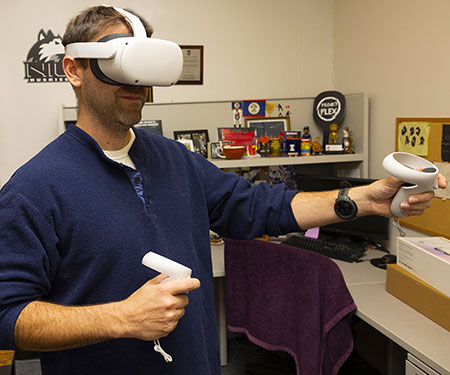
“You’ll see student behaviors, and this is how the teacher reacted. Was it successful? Could they have done something differently?” he says. “We can literally stop in real time and freeze and say, ‘We all saw that. Why did the student act that way? What are different outcomes that the teachers can do to try to adjust or change their students’ bad behavior?’ Then, you can play it, let the teacher go through and do whatever they’re going to do, and then we can pause it again and say, ‘This is what they did. Were they successful? Were they unsuccessful? Why? What would you do differently in the moment?’ ”
Going inside the goggles also lets the future teachers glimpse how students might react to an activity as well as their levels of interest or participation.
“They write lesson plans and say, ‘We’ll do Task One for 25 minutes,’ but if the students are disengaged in eight minutes, you’ll have to do something else, regardless of what’s in your plan,” he says. “Without seeing that in real time, it’s a lot harder to gauge that and to prep for that prior to going into the schools.”
Wahl-Alexander continues to plan for the integration of virtual reality in future courses.

He’s collecting a “better bank of videos” showing high-quality models of teaching to have ready when he brings the goggles back to his own classrooms.
Meanwhile, he’s also thinking about Project FLEX, the outreach initiative he co-directs with college Jenn Jacobs as the nation’s only sport-focused partnership between a university and a state juvenile justice agency.
“I want to video-record lectures from NIU faculty in a wide variety of content areas – business, music, art, finance, education and more – and essentially have banks of those for youth who are incarcerated,” he says. “Prior to their field trips to NIU, we can take them into a quote-unquote ‘NIU classroom’ in the VT setting to expose them to college a little bit earlier and provide a realistic opportunity of what college is going to look like from a class standpoint to get them excited.”
