
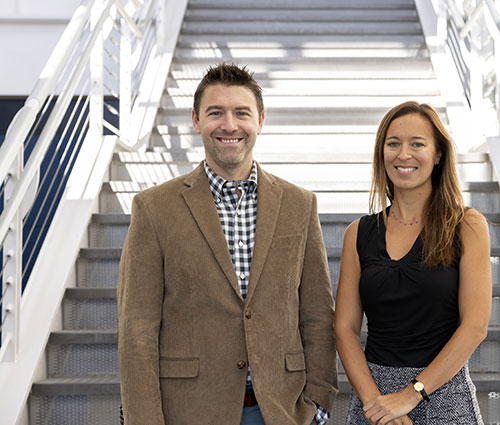
Project FLEX has secured a five-year, $2.55 million grant from the Illinois Department of Juvenile Justice (IDJJ) to continue and expand its work providing positive interventions with youth who are in secure custody of the state.
The NIU Department of Kinesiology and Physical Education initiative, launched in 2018 by faculty members Jenn Jacobs and Zach Wahl-Alexander, will use some of those dollars to fund a new program that will allow young men and women to earn certification as personal trainers.
Jacobs and Wahl-Alexander, who have managed Project FLEX with the help of graduate students, also plan to hire their first full-time staff member to manage administrative tasks.
Extra hands will prove critical.
- The professors hope to begin offering college courses inside the walls of the youth centers within a few years.
- More immediately, Project FLEX’s success with IDJJ has generated a separate invitation from officials of a federal prison where the NIU programming will debut later this month.
 “As much as Zach and I have tried to clone each other and replicate our abilities, that hasn’t been possible,” Jacobs says. “We’re fortunate that we’re going to have some support now, and we’ll continue to be able to carry a staff of about 10 to 12 graduate students each year, which is where we are right now.”
Both are grateful for the IDJJ’s funding of – and its confidence in – the nation’s only sport-focused partnership between a university and a state juvenile justice agency.
“It’s an endorsement of their trust in us, which is really great. They’ve been so supportive and so open to ideas,” Wahl-Alexander says. “It’s a testament to us, but it’s also a testament to the leadership of Illinois Department of Juvenile Justice and their willingness to invest in the youth.”
IDJJ Director Heidi Mueller confirms that the feeling is mutual.

“We highly value our partnership with Project FLEX and the opportunities that partnership has provided for our kids,” Mueller says, “not only through the Project FLEX program itself, but also through opportunities for our young people to explore higher education at NIU.”
Rob Vickery, deputy director of programs at IDJJ, says that Project FLEX “offers the young adults in IDJJ custody positive mentors who engage with them through fitness and sports.”
“This blend of relationship and fun creates a dynamic of positive growth for youth in our care,” Vickery says. “We are thrilled that Project FLEX now offers students an opportunity to earn a certification in personal training along with employment opportunities.”
Called “Personal Training for Life,” the latest component of Project FLEX is in partnership with the International Sports Sciences Association (ISSA).
“What’s so exciting is that we created this in response to what the IDJJ has been saying is a priority,” Jacobs says, “which is that we don’t want to just rehabilitate these kids while they’re incarcerated. We want to figure out ways to give them opportunities post-incarceration. The idea is that we’re setting them up with an actual, tangible skill and on-paper credential.”
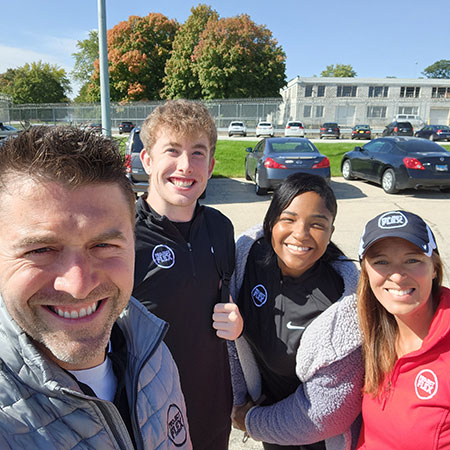
NIU graduate assistants Gabrielle Bennett and Jeremy Charles, who were trained by an ISSA instructor, now will deliver their own lessons in IDJJ’s St. Charles facility.
Youth chosen for the 12- to 15-week program will not only pursue certification as personal trainers but also will learn how to write effective résumés and cover letters and how to prepare for interviews.
Bennett and Charles work with three students at a time whose anticipated release dates closely coincide with the end of the training.
“We’ve identified jobs in the areas that the youth are going back to,” Wahl-Alexander says, “and once they leave the facility, they will essentially be able to step out into a working position.”
Multiplying the excitement is the involvement of Cam Paulson, a co-founder of Strive Village, which operates gyms in Chicago, Lake Forest, Western Springs and Wilmette.
Paulson visited Project FLEX and left impressed, Jacobs says: “He is interested in hiring our youth,” she says.
He also told some of his high-profile clients about what he saw, she adds, resulting in $100,000 in donations in less than one month. Those dollars will build and equip a state-of-the-art weight room at the IDJJ’s St. Charles facility and, as the Personal Training for Life program continues, youth who have completed the course can begin to teach it.
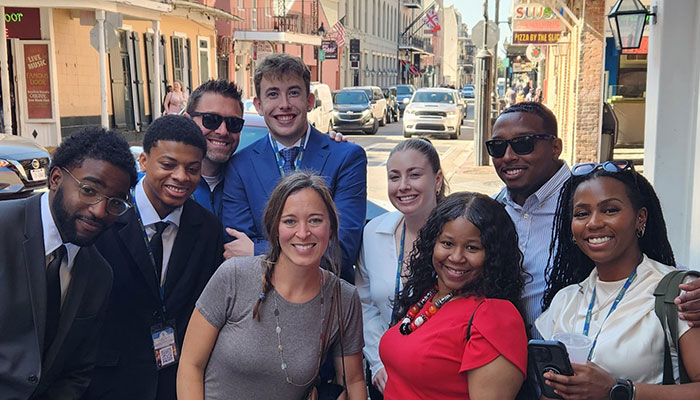
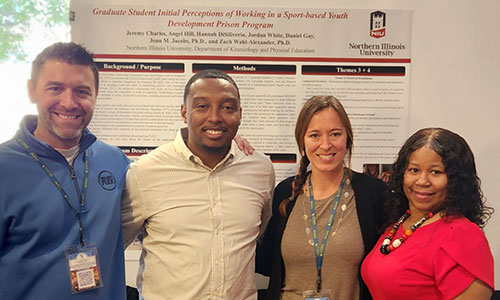
It’s all contributing to a rewarding fall for the FLEX group, who recently attended and presented at the North American Society for the Sociology of Sport Conference in New Orleans.
“Being in the juvenile justice world, everyone that we work with is hoping that we’re going to be out of business soon. That’s the goal. We don’t want kids to be incarcerated anymore, and that’s the model that we hope our state and our country is moving toward,” Jacobs says.
“But in the meantime,” she adds, “the goal is to hopefully get people doing kid-focused, thoughtful initiatives that aren’t just in consideration of money or aren’t in consideration of logistics or that put things like that before the needs of the youth.”
The duo remains optimistic and encouraged.
Jacobs keeps a folder called “Fan Mail” in her Outlook to store messages from other juvenile and adult correctional facilities and from other universities that have heard about Project FLEX and want to learn more:
“We’re starting to get more and more emails from outside entities, and we’re excited to share and hopefully see how others can adapt the same thing,” Jacobs says.
“I feel like this is the first time that Zach and I can shout from the rooftops with pride, because we’ve been doing this for a long time,” she adds. “It was never really about the affirmation of, ‘OK, here’s funding,’ or for other people to say what we were doing was good. But now we’re basking in the feedback of people who are affirming that this is helpful.”
