
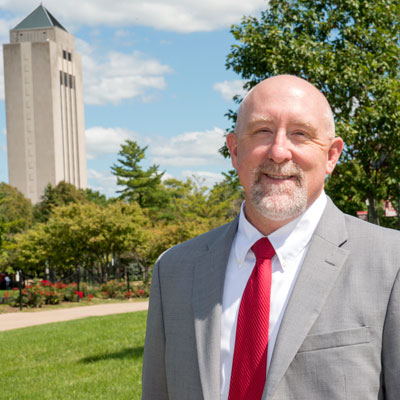
Bill Pitney knows exactly why he’s moving back to Graham Hall.
“The college’s mission really resonates with me,” says Pitney, professor of Athletic Training in the Department of Kinesiology and Physical Education.
“Our mission is grounded in high-quality teaching, research and service that prepares our students for personal and professional success, equipping them to be leaders and advocates for social change,” he says.
“I’ve always viewed higher education as existing to not only educate our students and provide them with meaningful learning experiences,” he adds, “but also to engage them in important research, scholarly activity and service that make a difference in our disciplines and, by extension, our communities.”
Pitney, the College of Education’s associate dean of Research, Resources and Innovation from 2016 to 2022, will lead the college as acting dean for the 2023-24 academic year while Dean Laurie Elish-Piper serves as NIU’s interim executive vice president and provost.
Elish-Piper is confident the college will thrive while Pitney occupies the dean’s office.
She and Pitney already have scheduled meetings to develop, implement and ensure a smooth transition.

“Dr. Pitney is the epitome of a servant-leader who works tirelessly to support faculty and staff so they can teach, advise and contribute to our students’ success. His deep knowledge of the College of Education and NIU will allow him to ‘hit the ground running’ as acting dean,” Elish-Piper says.
“Having had the privilege of working closely with Bill when he served as associate dean for Research, Resources and Innovation, and as acting vice provost for Faculty Affairs, I saw firsthand his capable leadership, ethical orientation, generous spirit and pragmatic wisdom,” she adds. “For these reasons, I know the college will be in great hands.”
A fixture of his department, the college and the university since 1994, Pitney plans to do more than steer the ship.
With him comes a résumé of not only athletic training but educator licensure as well; he majored in physical education at Indiana State University and then earned a master’s degree in physical education from Eastern Michigan University.
Recognition of his teaching includes the 2013 Outstanding Educator Award from the Great Lakes Athletic Trainers’ Association, the 2013 Dedicated Service Award from the Illinois Athletic Trainers’ Association, the 2015 Most Distinguished Athletic Trainer Award from the National Athletic Trainers’ Association (NATA) and the 2016 Sayers “Bud” Miller Distinguished Educator Award from the NATA’s Executive Committee on Education.
Completing his doctorate in adult continuing education at NIU laid an academic foundation for understanding and navigating the learning curves that awaited him, including a term as executive secretary of University Council and president of Faculty Senate for Fiscal Year 2015.

Learning also will play a part of his time in the acting dean role.
“In my earlier role as associate dean, I wasn’t as involved in the academic affairs side of things, but I care deeply about the experiences our students receive,” Pitney says. “I look forward to learning more in detail about what’s going on and seeing where I can make a difference to support our students as well as our faculty, advisors and staff who engage with our students.”
Years spent working alongside faculty in Physical Education, along with learning from Dean Elish-Piper and Jenny Johnson (the college’s former senior director for Student Success and, before that, director of Teacher Preparation and Development), kept him abreast of key initiatives and substantive developments in the K-12 realm.
Meanwhile, he became intimately familiar with the “ins-and-outs and requirements” of that world when he helped to negotiate a union contract with the college’s instructors who provide effective supervision to licensure candidates in their clinical and student-teaching requirements.
Such connections and experiences will provide avenues for guidance, Pitney says.
“We’ve got some talented folks on campus who know a heck of a lot more about that space than I do, and I’ve got good relationships with them, so I can ask the right questions at the right time to guide me in what we need,” he says. “I also know that we have incredibly talented department chairs and program directors who run programs that are licensure-related, so I think that leaning on them for direction and advice will be hugely helpful.”
Appropriately enough, Pitney plans to maintain Elish-Piper’s focus on the teacher shortage.
 While the college has proven successful in bolstering the pipeline “at the front end,” Pitney is troubled by reports showing that more than half of currently licensed teachers are considering an earlier exit from the profession than they had planned or expected.
“That doesn’t mean they’re going to go out and then leave right away, and we’re not seeing that with retention rates in Illinois, but the retention rates are still concerning,” he says.
“I’m thinking about the ‘back end’ of the pipeline – once our graduates enter the workforce and are in teaching positions – and I think there are opportunities to collaborate with our external partners to see how we can address their needs,” he adds.
“For example, are there any opportunities to bring educators together at that point in time where they’re engaged in their new roles? Is there a way to bring them together similar in fashion to the cohorts they went through to become trained educators in the PLEDGE or LEAP programs? Can we continue to bring them together to identify current issues and challenges that they’re facing?”
NIU stands ready to help, Pitney says.
“We’ve got a lot of talented faculty in our college who study some of those very things,” he says, “and I think we can lean on our experts locally to work with teachers in that regard and maybe make a difference in their continuance as educators in the school system.”
To faculty and staff, meanwhile, Pitney promises to serve with eyes, ears and mind open and with a heart of care and equity as they generate positive changes in the lives of students and subsequently advance the college in an upward direction.
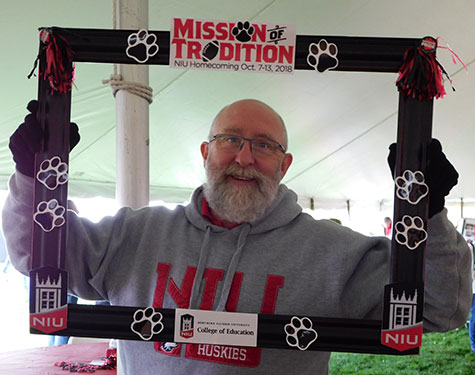
“I always try to be thoughtful,” he says, “and to approach circumstances and issues in measured manner with a lens toward our values as a college and with a lens toward our priorities as well as our capabilities – in terms of personnel who currently exist, in terms of finances that currently exist – so that we can carve out a win-win with any partnerships we develop and with any opportunities we take on.”
He highlights “thoughtful” and “measured” as critical components of his leadership.
“I need to learn. I want to learn. I’m hungry to learn. I want to know what’s on people’s minds, what they’re facing and how I can help,” he says.
“I look forward to being in a position where I can meet with department chairs, program directors, faculty and external partners to ask the questions with the preface that, ‘We probably can’t do everything, but we can do some things. Help me understand what you need, and where we can help.’ That’s what I bring to the table.”
Mostly, Pitney says, the year ahead reminds him of his upbringing in Peru, Indiana.
“Our students are real. They are authentic, in and of themselves. They’re facing the same things a lot of us faced as students; they’re honest about it and they work hard. I’ve always appreciated our students,” he says.
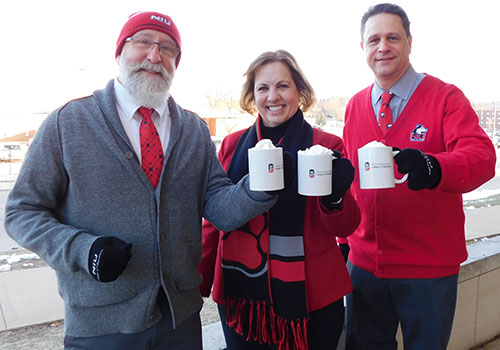
At the same time, “one thing I’ve always liked about NIU is our ability to meet students where they’re at.”
“You can take a student who might be struggling academically – getting through some of the tough classes of a discipline – and meet them where they’re at, giving them the support, mentoring them and getting them through the bumps to help them do better and to become the best version of themselves,” Pitney says.
Conversely, he says, faculty who work with Honors students and other Huskies who excel in the classroom “elevate their experiences to give them an incredibly meaningful education.”
“I think that’s always been cool,” he says. “We’ve got a range of students, and I think we do a good job of ‘getting it done,’ and this is, I would say, like being back home, whether working on a farm or playing on a sports team: ‘You have to step up and get the work done.’ ”
