
 Future teachers in KNPE 368: Sport Education typically practice their instructional ability on each other.
Not this semester.
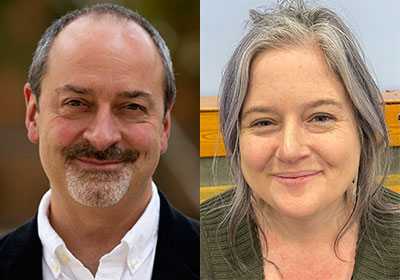
Paul Wright, the EC Lane and MN Zimmerman Endowed Professor in the Department of Kinesiology and Physical Education, has partnered with NIU STEAM to provide hands-on experiences with actual middle schoolers.
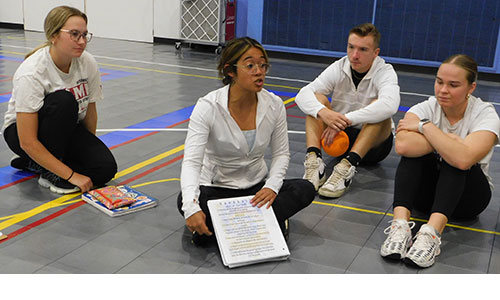
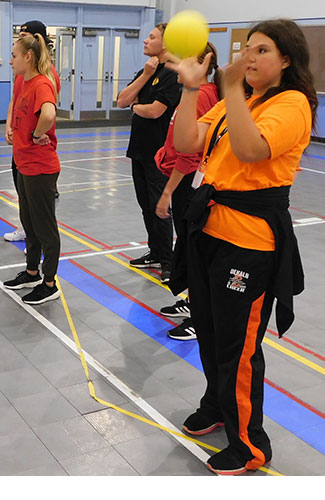
The sixth-, seventh- and eighth-graders from DeKalb’s Clinton Rosette and Huntley middle schools are coming to Anderson Hall from 4 to 5:15 p.m. Mondays and Wednesdays this month as part of the Barb City STEAM Team.
Offered at no charge to students receiving free or reduced lunch, the after-school program allows its participants to engage in STEAM activities and projects while also having fun and developing social skills.
Much of Wright’s career has focused on that final component of “developing social skills,” and the Barb City philosophy provides him the opportunity to show his future teachers why that matters.
In doing so, he expects his graduates will learn best practices and, eventually, improve outcomes for their own students.
“A lot of times, the way P.E. has introduced sports has not been very authentic,” Wright says. “You just say, ‘We’re going to do a six-week unit on handball,’ and then teach some isolated skills until the kids all have the skills. Then, you do some drills, and then, by the last couple of days of the unit, the kids can actually play a game. Then you move on to something else.”
Sport Education looks beyond that, he says.
Developers of that model wanted a way to “deliver a more authentic sport experience in P.E.” where students who might not participate in competitive sports gain a sense of being on a team, the concept of team affiliation and the responsibility of keeping records as well as preseason, regular season and postseason play and running tournaments.
“Within that, we also do a lot of empowerment-based activities where kids take on different roles,” Wright says. “One will be in charge of leading warmups. One will be the journalist in charge of getting some pictures and doing a little write-up.”
It’s making a positive impact, says Stephanie Dietrich, director of the Barb City STEAM Team.
About 35 middle schoolers are coming to campus daily Monday through Friday on provided bus transportation, she says. They are fed and offered enrichment courses as well as help with homework and studying.
Programming rotates monthly to keep the students engaged and interested; other collaborators include the NIU Women’s Basketball team, the Huskies Den (where they learned the physics of bowling), the DeKalb Public Library and Adventure Works.
The adolescents have enjoyed this month’s physical activity, Dietrich says, adding that “The mentorship from the NIU students has been phenomenal for them.”
“They’re getting the attention they need to learn the skills of handball, and they’re learning how to communicate and work together as a team, which has been great,” she says. “They also really think that the college students are cool, so they react very well to them.”
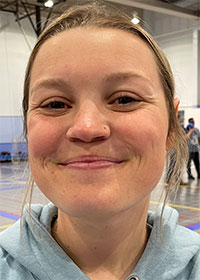
JOSIE KAMPWERTH, WHO is earning her M.S.Ed. in Kinesiology and Physical Education with initial educator licensure, confirms that.
“A couple of the kids on my team say they can’t wait to come,” says Kampwerth, a native of Peru, Ill., who worked as a middle school paraprofessional and for the Illinois Student Assistance Commission before deciding to become a P.E. teacher. “They like being able to be with us, and it’s always cool when you get to hang out with bigger kids.”
Coming to the NIU campus also provides a change in scenery, she says, and with it a change in attitude. Allowing the younger students to choose handball also is adding to the program’s success, she adds.
“They’re in a different environment than school, and a lot of times when it’s not a school-sanctioned activity, you get your kids who tend to goof off a little bit more,” Kampwerth says.
“But here, they know that, ‘OK, I’m learning how to be respectful. I’m learning how to be responsible. I’m learning how to be a good teammate and about good sportsmanship,’ ” she adds, “and when they start getting into their roles of officiating and coaching – once they learn that leadership role, and the doing-the-right-thing part of it – I think that’s going to be really helpful for them at their age.”
Kampwerth is finding the Barb City interactions helpful for herself as well.
“We were literally lucky that we were able to have this program come in and that we could work with actual students,” she says.
“For me, it’s really nice that I’m already thinking about lesson plans in my head – that if I were to do a handball unit, this is what I’ll need to start with,” she adds. “It’s really good for me to start seeing a format of how I want to implement a sport education curriculum, and it’s also really good just being able to connect with kids.”

Ryan Ingalls, an M.S.Ed. student from Oswego, also appreciates the opportunity.
“This is something we can use in our field in order to get more student involvement and to get the students to have more fun because it’s using sports to teach them about life,” says Ingalls, who plans to teach high school P.E.
“They are able to have more initiative in what they’re doing so that they feel involved,” he adds. “It’s something that belongs to them, so they’re more willing to do things.”
Ingalls, who coaches football, wrestling and track and field, says the course is already paying dividends in his coaching. He’s seen the benefit of allowing his athletes to “kind of take charge” rather than always being the ones taking direction.
Meanwhile, he says, “just being able to work with the students is great because the more I work with them, the more comfortable I feel.”
P.E. MAJOR LACI SLIGAR, who recently worked with children in the NIU STEAM summer camps, is now student-teaching in District 231 in nearby Rochelle.
Scheduled to graduate in December, she’s already completed KNPE 368, but was grateful for the opportunity to participate this fall.
“After the summer, they had asked me if I would help out with the after-school program. I love the team here at NIU STEAM and had no hesitation to continue working for them,” Sligar says.

“Working with the Barb City STEAM kids has been an awesome opportunity for me and has worked out great with my student-teaching schedule,” she adds. “I still get to do what I love – working with kids, planning different activities for the kids to keep them physically active/moving and teaching them the importance of teamwork and collaboration amongst one another.”
Sligar is “getting to see how much the Sport Education model has a positive impact on the STEAM kids.”
“Each student has their own role within their teams and that makes the kids feel special and appreciate gameplay more – they’re getting more involved, and their role is a key aspect to their teams’ success,” she says. “I am also learning different ways the model can be facilitated and what I could change in my own teaching to make it better and better each time I use it myself.”
Her elementary students in Rochelle are the current beneficiaries, she says.
“I’m doing a Sport Education season of my own with my elementary students because I loved this class so much. The shift from a winning mindset to a mindset where students exemplify sportsmanship, fair play and respect for one another and the game is so valuable and so important for my students to learn,” Sligar says.
“Integrating fair play has really helped my students appreciate their classmates and physical education class so much more. It’s been a great feeling seeing the kids so excited to come to my class after introducing the model to them,” she adds. “The bonds I have formed with my students, as well as the bonds they have formed with one another after the integration of this model, have held some of the best moments of my teaching career thus far.”
DEDRIC WRIGHT, AN M.S.ED. student from Sycamore, is unsure of his professional destination.

Wright initially wanted to teach P.E., he says, but is also considering a career in health care of some sort: “My goal,” he says, “is to help people.”
No matter where he lands, he’s grateful for what he’s learning in the Sport Education class.
“I have a coaching background, so I’ve always been around kids, and this gives me a better outlook on kids in the educational environment,” Wright says. “It’s very beneficial for me see how kids interact with each other outside the actual field of play. It gives me an idea of what it’s going to be like to teach.”
So far, he adds, it’s much like coaching.
“We’re showing the kids how the Sport Education model works, and then we’re kind of handing it over to them slowly so that they can become the scorekeepers, the equipment people and the coaches themselves to basically run the team themselves,” he says.
“That gives them a bit of ownership, gameplay and just builds a foundation of teamwork and how a team functions,” he adds. “Throughout our lives, we have to work with people. Everyone has a role to play – just like sports; just like real life – and this is an opportunity to have a role, to get familiar with that role, to understand that role and then to do your part to keep the team going.”
Jazmin Pestano, a P.E. major from Hoffman Estates, sees that happening in the Anderson Hall gym.
“You’re targeting all three domains – psychomotor, cognitive and affective – and being in the team setting, you’re really working on that affective domain, working with each other socially,” Pestano says.
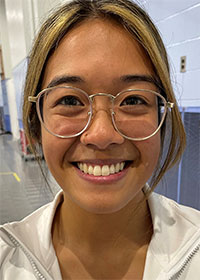
“Because of COVID, we did have those two years that were practically off and remote, so it’s nice to see the kids interact with each other,” she adds.
“They’re working in teams and learning to work with each other, whether they enjoy each other’s presence or not. It’s just like real-life opportunities and real-life circumstances. We’re not always working with people we typically enjoy working with, and it’s nice to be able to expose them to that.”
Pestano, a junior on track to graduate next fall, also appreciates her chance to practice teaching.
“I’m learning that not everything is going to go your way. You’re going to have some behavior management issues, and you’ve always got to have that Plan B, Plan C, Plan D on the fly to do what you want to do,” she says.
“It’s also nice to be able to team-teach so you can bounce ideas off of each other,” she adds. “Not every time am I going to have the right answer or even just an answer in general. I’m starting to get used to saying, ‘I don’t know – but I will find out.’ ”
PAUL WRIGHT IS HAPPY with the maiden voyage of this KNPE-STEAM collaboration.
He began the semester in August “heavier on the readings” so that his students would quickly become steeped in the concept, structure and vocabulary of the Sport Education model.
As the experiential phase winds down in early November, he will shift toward reflection.
 “We’ll have the last part of the semester to really sort of digest and debrief,” Wright says.
“They’ve created all these materials – I’m having them give assessments to the middle school students – and they’re going to have time to go through the process of breaking down and analyzing the assessments,” he adds. “They’ll also do reports on student learning, and identifying things they think they could have done differently, so it’s going to be an authentic cycle for them between planning something, implementing it and then analyzing and interpreting what happened.”
Meanwhile, his students are gaining the experience of not only creating a unit and individual lesson plans but also enacting them.
“In teacher education programs, we have them do so much planning – which is important – but I think I’m not too worried about their ability to generate lesson plans anymore,” Wright says. “I think you get to a point where, ‘OK, we know how to develop a plan. Now let’s actually get out there and learn how we work on our feet when only half the kids we expected showed up today because it was tryouts for dance and basketball, and now this group has three kids instead of seven and this group only has one kid.’ ”
 That challenges “our comfort zone,” the professor says, because attendance and structure in after-school programs can differ greatly from physical education classes during the school day; Wright’s students have had exposure to regular physical education settings, he says, but many are getting used to working in an after-school setting.
“We get thrown for a loop. We get taken by surprise. We have behavior issues with kids. You can’t plan out every minute. You don’t have a crystal ball. Your lesson plan has no guarantee that that’s how the day is going to go,” Wright says.
“It has stretched some of my KNPE 368 students who like to know exactly what we have to do and how it’s going to run. They want everything laid out for them and pinned down. This has forced them to get a little more comfortable with being loose and flexible, which I personally think is a nice thing to give them exposure to and some comfort with,” he adds.
“It’s thrown a different dynamic that I think is very healthy for them. It’s been positive. I see them growing and stepping up.”

